





What You'll Discover:
- Why the empty nest changes drinking before almost anything else changes.
- How loss and freedom can arrive in the very same week.
- What research shows about drinking after children leave home.
- Why a midlife body handles the same pour differently.
- How couples' habits tend to shift together after the kids go.
- Practical ways to build a new structure that feels like yours.
For eighteen-plus years, your evenings had a shape. Dinner at a certain time, homework checks, a practice to drive to, a curfew to wait up for.
Then one weekend you unload a car at a dorm or carry a couch up three flights into a first apartment. You drive home, and the house is very quiet.
A glass of wine at six feels like a small, reasonable comfort. For a lot of parents it stays exactly that. For some, the one glass slowly becomes the main event of the evening.
If that sounds familiar, nothing is wrong with you. Something big just changed, and the drink moved into the open space before anything else had a chance to.
What the Empty Nest Quietly Removes
Parenting supplied a remarkable amount of structure, and most of it was invisible. There was always a next thing, and the next thing usually required a clear head.
You might need to drive across town at nine for a pickup. You waited up for a curfew. You were the designated driver for years without ever deciding to be one.
None of that was designed to limit your drinking. It limited your drinking anyway.
When the kids leave, those natural brakes come off all at once. Nobody needs a ride at nine. The third glass has no late-night cost, and often no early-morning one either.
Then there is the role itself. Your children still need you, just differently, and much less often at 7pm on a Tuesday. That leaves a real gap in an identity you have carried every single day for two decades.
If retirement is arriving around the same time, the two transitions stack. We cover that overlap in our guide to alcohol and retirement, where the same loss of structure plays out with work.
Loss and Freedom in the Same Week
The empty nest is rarely just sad. For most parents it is sad and freeing at the same time, sometimes in the same afternoon.
Researchers describe this with two competing forces. The first is role loss, the grief of no longer doing the daily work of parenting. The second is relief from role strain, the very real lightness of not carrying that load anymore.
A review of parents' well-being in this stage found that some parents lose well-being through role loss while others gain from role strain relief and more social engagement.
The older assumption that the empty nest is mostly harmful has largely not held up once researchers asked the parents actually living through it.
So you can miss them terribly and also love that the kitchen finally stays clean. Both are true, and neither needs defending.
Here is the catch. Wine works for both feelings. It softens the ache on the hard nights and toasts the freedom on the good ones, which is exactly why it fills the empty nest so neatly.
What Research Shows About Drinking After Kids Leave
This is not just a hunch. A recent study using data from English households found that drinking tends to rise after adult children move out.
The increase came mostly as more regular drinking, plus a moderate rise in how much people drank on a given day. The effects were strongest among couples, higher earners, people still working, and adults aged 45 to 60.
The researchers pointed to relaxation and changes in how people spend their time as the main drivers. So this is not a story about crisis. It is a story about drift.
The broader trend in the U.S. points the same way. A national analysis found that the odds of binge drinking among women ages 30 to 49 rose about 7 percent per year between 2006 and 2018.
Many of today's empty nesters spent their parenting years inside the "mom needs wine" message, which we look at in our piece on mommy wine culture. The kids leave. The wine habit often stays.
Why the Same Glass Lands Differently in Midlife
The empty nest tends to show up right when your body is changing how it handles alcohol. The timing is a coincidence, but it matters.
For women, the menopausal transition often overlaps with the kids leaving. One study followed more than 3,300 women for ten years, starting when they were 42 to 52.
In that group, women were more likely to begin excessive drinking in early perimenopause and after menopause. Hormones, hot flashes, and broken sleep all arrive in the same years as the quiet house.
The same study also tracked plenty of movement in the other direction, with many women stepping back from excessive drinking over the decade. These patterns are not fixed.
Sleep shifts for everyone in midlife, men included. Alcohol makes it easier to fall asleep and then fragments the second half of the night, which is a worse trade at 52 than it was at 32.
Hangovers last longer too. Two glasses can leave you foggy the next morning in a way that used to take four. Many of these changes begin earlier, as we explain in our guide to turning 40 and rethinking drinking.
Rediscovering Your Marriage, or Yourself
For couples, the empty nest can feel like meeting each other again. The kids were a shared project, a constant topic, and a buffer. Without them at the dinner table, it is just the two of you.
That can be wonderful, awkward, or both in the same evening. And when conversation feels unfamiliar, opening a bottle together is the easiest shared activity in the house.
Research on couples suggests that what you do together matters more now. In German and Australian couples followed for more than two decades, partners' health and well-being trajectories became much more closely matched after the empty nest.
The authors suggest that shared transitions can put couples on a mutual upward or downward path. Put simply, your evening habits are likely to become your partner's, and theirs yours.
That is genuinely good news if you want to change. One partner swapping wine o'clock for an evening walk can reset the rhythm for both people.
If you are single, divorced, or widowed, the quiet can be a lot louder. Loneliness and drinking feed each other in a loop we explain in our guide to alcohol and loneliness.
Finding the Person Under the Parent
There is a quieter question underneath all of this. For two decades, a lot of your choices were made around someone else's schedule, and some of the things you loved got shelved along the way.
The empty nest hands them back. The instrument in the closet, the friend you lost touch with, the trip you kept postponing, the career idea you never had time to test.
A glass of wine is a perfectly pleasant way to avoid that question for an evening. It is a less pleasant way to avoid it for a year.
Curiosity tends to work better than resolve here. Try three small things in the first season and keep the one that makes you lose track of time.
Weekends, Holidays, and Visits Home
Weeknights get most of the attention, but weekends change just as much. Saturdays used to belong to tournaments, birthday parties, and errands. Now a long open afternoon can start with a glass at lunch.
Visits home bring a rhythm of their own. The house fills up for Thanksgiving or a summer week, the celebrations flow, and then everyone leaves at once and the quiet lands even harder.
Many parents notice their drinking spikes in the days right after a visit. That is grief showing up in a familiar form.
It is also very plannable. Put a walk, a call with a friend, or a project with a start time on the calendar for the day after goodbyes, before the visit even begins.
What the Empty Nest Removes and What Fills the Gap Well
The most useful way to look at all of this is as a trade. Parenting provided services you never signed up for, and now you get to choose the replacements yourself.
| What the empty nest removes | What tends to fill the gap | What fills it well |
|---|---|---|
| The dinner rush and evening schedule | An open-ended evening that starts with a pour | A fixed evening anchor, like a class, a walk, or a standing call |
| A reason to stay sharp at night | The third glass has no late-night cost | A self-chosen reason to be clear at 10pm, like an early plan the next day |
| The daily hands-on parenting role | Drinking to sit with "who am I now" | One project with a real deadline and a person expecting results |
| Kids as the couple's shared focus | Wine as the main thing you do together | One new shared activity with no drink attached |
| Built-in contact through school and sports | Quiet weekends with fewer reasons to go out | Two recurring in-person commitments on the calendar |
Building a New Structure You Actually Chose
The fix here is not white-knuckle abstinence. It is rebuilding the structure parenting used to provide, this time on your own terms.
Start with two weeks of honest tracking. Write down every drink with no judgment attached. Most people find the true number runs a little higher than memory suggests, and seeing it in writing tends to shift behavior on its own.
Then give your evenings a new anchor. The hour between five and seven is usually where the habit lives, so put something specific there.
A few ideas that work well for empty nesters:
- A class with a set start time, like pottery, a language, or a fitness session.
- A standing weekly dinner or call with a friend.
- Volunteer hours that ask something real of you.
- Alcohol-free weeknights, chosen in advance rather than in the moment.
- One "someday" project, finally given a deadline.
Attach the first drink to an event, like dinner, rather than to a mood. That one small rule keeps the glass from drifting earlier into the afternoon.
And give yourself credit for the parenting years. You were extremely good at building structure for other people. Now you get to aim that skill at yourself.
When You Want a Little More Support
For some people, a new routine is enough. For others, the evening pull is strong enough that extra support makes the change easier and faster.
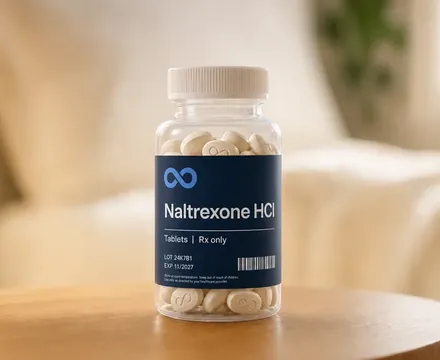
Naltrexone is an oral 50mg tablet, FDA-approved for alcohol use disorder since 1994. It blocks the opioid receptors involved in alcohol's reward, so drinking feels less rewarding and the urge for another glass quiets down.
People use it to drink less or to stop entirely. It is not habit-forming. It cannot be taken with opioid pain medications, though, and a clinician should review your health history and current prescriptions first.
Choose Your Horizon pairs naltrexone with physician-guided care, coaching, and progress tracking. It is an integrated solution grounded in clinical, neurological, and behavioral science, available online in all 50 states.
You do not need to wait for drinking to become a problem before wanting support. Wanting your evenings to feel better is reason enough.
Your Next Chapter Can Be Clearer
The empty nest removes the daily structure of parenting, and alcohol is very good at filling open evenings. That is a common, human response to a big change.
Loss and freedom often arrive together. Midlife bodies handle alcohol differently, and couples' habits tend to move as a pair once the kids are gone.
This stage is also a genuine opening. You have time, hard-won experience, and more say over your evenings than you have had in decades.
Building the next chapter with a clearer head is not about giving something up. It is about choosing what goes into the space.
Frequently Asked Questions
Is it normal to drink more after the kids leave home?
It is common. Research on households in England found that drinking tends to rise after adult children move out, mostly through more regular drinking.
What is empty nest syndrome?
It is a popular term, not a clinical diagnosis, for the sadness and loss some parents feel when children leave home. Many parents also feel relief and new freedom at the same time.
Does menopause change how alcohol affects me?
It can. In one long-term study, women were more likely to begin excessive drinking during early perimenopause and after menopause, and alcohol's effect on sleep often feels worse in midlife.
How can my partner and I reconnect without drinking?
Pick one new shared activity with no drink attached, like a weekly walk, a class, or cooking something new together. Couples' habits tend to move together, so one change often helps you both.
How do I know if my drinking is becoming a problem?
Signs worth noticing include drinking more than you planned, needing more to feel the same effect, or feeling uneasy on nights without it. A clinician can help you make sense of what you are seeing.
Can naltrexone help if I only want to drink less?
Yes. Naltrexone is used by people who want to cut back as well as by people who want to stop entirely.
When you are ready to make your evenings feel like your own again, start with one quick, private step. Take the Alcohol Use Assessment to see whether naltrexone could fit this new chapter.
A private, physician-led plan to drink less or quit.
Medication, coaching and support from home. A short assessment is the first step.
Start Assessment