




What You'll Discover:
- Why job loss affects drinking from three directions at once.
- What recession-era research found about unemployment and alcohol.
- Why empty days are one of the strongest triggers.
- The financial irony of drinking more when money is tight.
- A practical daily structure to replace what work used to provide.
- How cash-pay telehealth fits when your insurance is gone.
Losing a job is one of the most stressful things that can happen to an adult. It rarely arrives as a single loss.
In one meeting you can lose your income, your daily routine, your coworkers, and a big piece of how you describe yourself.
So if you've noticed you're drinking more since the layoff, you're not weak or broken. You're responding to a real shock with a tool that works fast. The trouble is that alcohol tends to make every part of this situation harder.
The good news is that the pattern is well understood. Once you see what's driving it, you can replace it piece by piece.
Why a Layoff Hits Drinking From Three Directions
Most stressful events take one thing from you. A layoff usually takes three.
Structure. Work told you when to wake up, when to eat, and when the day was over. Without it, the hours stretch out with nothing to mark them.
Identity. For many adults, a job is the answer to "what do you do." Losing it can leave you feeling unanchored, along with a sense of shame you didn't ask for.
Income. Money stress runs in the background all day. Every bill, grocery run, and recruiter email carries extra weight.
Each of those losses is a known trigger for drinking on its own. Together, they create ideal conditions for a 5pm drink to become a 2pm drink, and for one drink to become four.
What Research Says About Job Loss and Drinking
Decades ago, psychologist Marie Jahoda proposed that work gives people far more than a paycheck. A 2023 meta-analysis tested her idea across many studies.
It found that employed people reported higher levels of time structure, social contact, collective purpose, status, and activity than unemployed people. Together, those factors explained 19% of the variation in mental health.
In other words, losing the hidden benefits of work measurably affects how people feel, separate from the money.
Research on drinking comes largely from the Great Recession of 2008 and 2009, when millions of people lost jobs around the same time. A U.S. study of 5,382 adults from the 2009 to 2010 National Alcohol Survey looked at what happened next.
It found that severe economic loss, meaning job or housing loss, was linked to more negative drinking consequences and alcohol dependence. Men and middle-aged adults were at risk for several alcohol problems at once.
A Dutch study linked national health surveys from 2004 to 2013 with tax records of people's work histories. Before the 2008 crisis, job loss wasn't associated with harmful drinking.
During the crisis, being out of work for more than six months was tied to about 40% higher odds of episodic heavy drinking. Current job loss was tied to similarly higher odds of chronic heavy drinking, and the effects were clearest in men.
All that said, the picture isn't one-directional. A study of more than 2 million U.S. adults, published in Alcohol and Alcoholism in 2013, found that slightly fewer people drank at all during the recession, from 52.0% to 51.6%.
At the same time, frequent binge drinking rose from 4.8% to 5.1%. Young, unmarried men who had recently lost their jobs were at highest risk.
So hard times push some people to cut back, often because money is short, and push others toward heavier drinking. If you're in the second group, you're part of a well-documented pattern, not a personal failing.
Empty Days Are a Powerful Trigger
When work ends, the clock loses its landmarks. There's no commute, no lunch break, no moment when you close the laptop and the day is officially done.
Researchers who study unemployment describe how open-ended time can slide into chaotic, squandered days, which then feed low mood. Many people who've been laid off recognize that description right away.
Alcohol fills empty time unusually well. It's a ritual, it marks a transition, and it makes slow hours feel shorter. That's exactly why it can take over.
Boredom and avoidance tend to travel together. A drink can be a way to put off the job application, the hard phone call, or the feeling of not knowing what comes next.
Our guide to alcohol and avoidance explains how that cycle builds and how to interrupt it.
Drinking to Cope With Stress and Shame
Job loss often brings a heavy emotional load. Anxiety about money, grief for a role you loved, anger about how it happened, and embarrassment about telling people can all show up in the same week.
Alcohol takes the edge off those feelings for an hour or two. Then it tends to hand them back, through worse sleep, lower mood the next day, and less energy for the things that would actually help.
Over time, the brain learns the shortcut. Feel stressed, pour a drink, feel briefly better. That loop is a learned pattern, not a character flaw, and it can be unlearned.
Our article on how to stop using alcohol as self-medication breaks down how.
Shame deserves its own mention. Many people avoid telling friends or family about a layoff, and that secrecy can make an evening drink feel like the only safe place to set the feeling down.
A simple, honest line helps, such as "my role was cut, and I'm figuring out what's next." Saying it plainly once makes the next time easier, and it opens the door to support you might not expect.
Support makes a measurable difference here. A study of recession-era job loss found that higher family social support reduced the effect of job loss on psychological distress.
The same research found job loss was linked to alcohol use disorder through increased drunkenness. That's one more reason reaching out early matters.
Signs Your Drinking Has Changed Since the Layoff
Drinking patterns rarely change overnight. They drift, and the drift is easy to miss when every day looks the same.
A few signs are worth noticing. The first drink comes earlier than it used to. You drink on weekdays when you once saved it for weekends. You keep more alcohol in the house than before.
Other signs are about how drinking fits into your day. You skip applications or calls because you're hungover. You drink alone more often. You feel uneasy when you think about a night without a drink.
Spotting one or two of these signs doesn't mean something is wrong with you. It means the habit is filling a gap, and that gap can be filled another way.
The Financial Irony of Drinking More on Less
Here's the part nobody wants to say out loud. Drinking more after a layoff often means spending more on alcohol at the exact moment income disappears.
Run a quick example. A $15 bottle of wine five nights a week is $75 a week, or roughly $300 a month. Add a few nights out or a case of beer for the weekend, and the total climbs fast.
That number doesn't include the hidden costs. Hangovers eat into job search hours, poor sleep dulls interview performance, and low mood makes it harder to reach out to your network.
Looking at the real number can be motivating rather than shaming. Our breakdown of the real cost of drinking can help you add it up honestly and see what cutting back frees up.
Rebuilding a Daily Structure Without Alcohol
The most effective response to lost structure is new structure. It doesn't have to be elaborate. It just has to be consistent enough that your days have edges again.
Keep a fixed wake-up time. Pick a time and keep it, weekends included. A predictable morning is the anchor everything else hangs on.
Treat the job search like a part-time job. Block set hours for applications and networking, then stop. Ending the workday on purpose gives you the boundary your old job used to provide.
Schedule people. Put at least two calls or meetups on the calendar each week. Former coworkers, friends, a support group, or a volunteer shift all count.
Move every day. A walk, a run, or a workout gives the day shape and helps with sleep and mood.
Decide your drinking rules in advance. For example, no drinking before 6pm, no drinking alone, or alcohol-free weeknights. Rules made in the morning are easier to keep than decisions made at 4pm.
Build an evening replacement ritual. If the first drink marked the end of the day, swap in something else that does the same job, like a walk, a shower, cooking dinner, or a specific alcohol-free drink.
What Job Loss Removes vs a Structure That Replaces It
| What job loss removes | How it can show up at home | A structure that replaces it |
|---|---|---|
| Time structure | Waking late and drifting through the afternoon | A fixed wake time and set job search hours |
| Social contact | Days without a real conversation | Two scheduled calls or meetups each week |
| Purpose and status | Feeling useless or ashamed | A volunteer role, class, or project with a deadline |
| Daily activity | Long stretches on the couch | A daily walk or workout at the same time |
| Income | Money stress, plus spending on alcohol | A weekly budget with alcohol as its own line |
Getting Help Without a Job or Insurance
Losing a job often means losing employer health insurance, and that can make help feel out of reach. The short answer is that it's more accessible than many people think.
Cash-pay telehealth for alcohol is one option. You can see a clinician online without an insurance claim and without traveling to an office.
Our guide to online alcohol treatment without insurance walks through how it works and what to look for.
Free help exists too. SAMHSA's National Helpline is free, confidential, and open 24/7 at 1-800-662-4357. It can refer people without insurance to state-funded treatment options.
One safety note matters here. If you've been drinking heavily every day, stopping suddenly can trigger withdrawal. Talk with a clinician before you quit, and get emergency care right away for shaking, confusion, hallucinations, or seizures.
How Choose Your Horizon Can Help
Choose Your Horizon offers alcohol care that's 100% online and discreet. You can start from home, on your own schedule, which matters when your days are already full of uncertainty.
Our integrated solution combines naltrexone with physician-guided care and coaching support, grounded in clinical, neurological, and behavioral science. Prescriptions come from real medical doctors, and medication ships discreetly to your door.
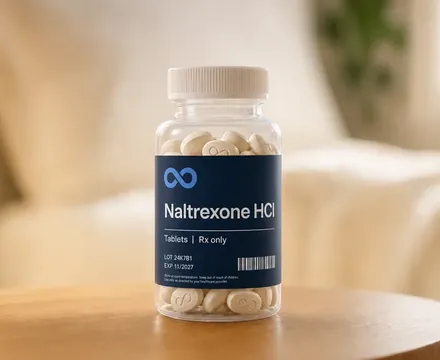
Naltrexone is an FDA-approved daily 50mg tablet, and it's available as a generic, which helps keep costs down. It blocks the opioid receptors involved in alcohol's rewarding effects, so drinking feels less rewarding and cravings ease.
You choose the goal. Some people want a full break from alcohol during a hard season. Others want to cut back to a level that feels manageable. Both are legitimate, and naltrexone supports either one.
Many people find that once cravings ease, the rest of the plan gets easier. The fixed wake time sticks. The job search hours happen. The evening walk replaces the evening bottle.
Rebuilding From Here
Job loss removes structure, identity, and income all at once. Research from the Great Recession shows that heavier drinking often follows, especially for men and for people out of work for months.
You can replace what work used to provide. A fixed schedule, regular contact with people, daily movement, and clear drinking rules give your days shape again, and support from the people around you makes a real difference.
Reaching out about your drinking during a layoff isn't one more failure to add to the pile. It's one of the most practical things you can do for your next chapter.
Frequently Asked Questions
Is it normal to drink more after losing a job?
It's common. Research from the Great Recession found that job loss, especially long-term job loss, was linked to heavier and more harmful drinking, particularly in men.
How do I stop drinking out of boredom while unemployed?
Give your days structure with a fixed wake time, set job search hours, daily movement, and scheduled time with people. Then replace the evening drink with a different end-of-day ritual.
Can drinking hurt my chances of getting hired?
It can. Hangovers, poor sleep, and low mood make it harder to apply consistently, stay in touch with contacts, and perform well in interviews.
Can I get alcohol treatment without insurance?
Yes. Cash-pay telehealth lets you see a clinician online without an insurance claim, and SAMHSA's free National Helpline can refer you to state-funded options.
Can job loss lead to alcohol use disorder?
Job loss alone doesn't cause it, but research links severe economic loss to higher rates of drinking problems and alcohol dependence, especially in men and middle-aged adults. Stress, empty time, and isolation all play a part.
Should I quit drinking completely after a layoff?
That depends on your health and goals. Some people take a full break, while others cut back. If you drink heavily every day, talk with a clinician before stopping.
Find out whether naltrexone could help you take back control during a hard season. Take the Alcohol Use Assessment online and privately, and a physician will review your answers and recommend next steps.
A private, physician-led plan to drink less or quit.
Medication, coaching and support from home. A short assessment is the first step.
Start Assessment