


What You'll Discover:
- How online GLP-1 care for drinking works, step by step.
- What a legitimate provider screens for before prescribing.
- The telehealth red flags the FDA tells consumers to watch for.
- Why GLP-1s are off-label for alcohol and naltrexone is approved.
- How a physician-guided GLP-1 and naltrexone combination fits.
GLP-1 medications have gone from diabetes clinics to dinner-table conversation. A lot of people have noticed they drink less on them, and many now want to explore that with a doctor.
Getting that care online can be convenient, private, and effective. It can also be confusing, because not every website offering GLP-1s offers real medical care.
This guide walks through what legitimate online care looks like from start to finish. It also covers the warning signs that mean you should keep looking.
An Honest Note on Approval
Before anything else, it helps to know where GLP-1s stand. Semaglutide (Ozempic and Wegovy) and tirzepatide (Mounjaro and Zepbound) are FDA-approved for type 2 diabetes, weight management, and certain related conditions.
They are not FDA-approved for alcohol use disorder. Prescribing them to help with drinking is off-label.
Off-label prescribing is legal and common. The FDA explains that clinicians may prescribe an approved drug for an unapproved use when they judge it medically appropriate.
The FDA also notes that it hasn't determined the drug is safe and effective for that unapproved use. That's exactly why the prescriber and the follow-up matter so much.
The research on GLP-1s and drinking is promising but early. A randomized trial of once-weekly semaglutide in adults with alcohol use disorder found it reduced craving and drinks per drinking day over nine weeks, in a group of 48 people.
The authors called it initial evidence that justifies larger trials. Real-world health record studies point the same way, but they can't prove cause and effect.
Naltrexone is a different story. It has been FDA-approved for alcohol use disorder since 1994 and has decades of clinical trials behind it. A good provider will be upfront about that difference.
How Online GLP-1 Care for Drinking Works
Telehealth is a recognized way to get alcohol care. NIAAA lists virtual and telehealth visits as a form of outpatient treatment for medication support, counseling, or both.
Here's what a legitimate process usually looks like.
Step 1: An Online Assessment
You start by answering questions about your drinking, your goals, your health history, and your current medications. A good assessment asks about patterns, not just totals, such as heavy days and how you feel when you don't drink.
Step 2: Review by a Licensed Clinician
A licensed prescriber reviews your answers. They may message you with follow-up questions or ask for recent lab work. This is a real medical evaluation, not a checkbox.
Step 3: Screening for Contraindications
The clinician checks for reasons a particular medication might not be safe for you. More on what that includes below.
Step 4: A Prescription, If Appropriate
If a medication makes sense, the clinician prescribes it and a licensed pharmacy fills it. If it doesn't make sense, a good provider will say so. A prescription is never guaranteed.
Step 5: Ongoing Follow-Up
GLP-1s start at a low dose and step up over weeks, so follow-up matters. Your clinician should check in on side effects, drinking, and progress, and adjust the plan as you go.
For a broader look at how this works for alcohol care in general, our guide to telehealth alcohol treatment covers the basics.
What to Have Ready for Your Assessment
A little prep makes the assessment more accurate and saves back-and-forth later.
Your drinking, in numbers. A rough weekly count and your heaviest day are more useful than "socially." Nobody is judging the numbers. They're what keep you safe.
Your medication list. Include prescriptions, over-the-counter products, and supplements.
Your health history. Note any past pancreatitis, gallbladder issues, family history of medullary thyroid cancer, liver problems, or stomach conditions.
Recent lab results. If you've had blood work in the past year, having it handy can help your clinician.
Your goal. Cutting back, taking breaks, and quitting are all valid starting points. You don't need to have it all figured out.
What a Legitimate Provider Screens For
Screening is where real care shows up. Before prescribing, a careful clinician will want to know about:
- A personal or family history of medullary thyroid cancer or MEN2, which rules out GLP-1s.
- Past pancreatitis or gallbladder problems, both listed as warnings on GLP-1 labels.
- Severe gastroparesis or other conditions that slow your stomach.
- Pregnancy, plans to become pregnant, or breastfeeding.
- Diabetes medications that can cause low blood sugar.
- Current or planned opioid use, since naltrexone blocks opioids, and any liver disease.
They'll also ask how much you drink and whether you've had withdrawal symptoms. If you drink heavily every day, stopping suddenly can be dangerous, so your clinician may plan a safer way to cut back.
Mental health history matters too. A good provider asks about mood and sleep as part of the full picture.
What a Legitimate GLP-1 Telehealth Provider Looks Like
Beyond screening, a few qualities separate real care from a storefront.
A real prescriber you can reach. You should know who is prescribing, and that person should be licensed in your state. You should be able to ask questions before and after you receive medication.
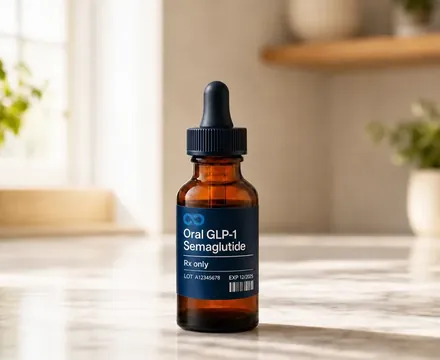
FDA-approved or properly sourced medication. The FDA recommends getting a prescription from your doctor and filling it at a state-licensed pharmacy. Compounded versions should only be used when an FDA-approved drug can't meet your medical needs.
Ongoing monitoring. GLP-1 titration takes months. A legitimate provider checks in as doses change, watches for side effects, and tracks your drinking along the way.
Honesty about the evidence. A good provider tells you GLP-1s are off-label for alcohol, explains what the research does and doesn't show, and doesn't promise results.
Clear privacy practices. Care should be confidential, and medication should arrive in discreet packaging.
Our guide to whether online alcohol treatment is legit goes deeper on what to look for.
Red Flags the FDA Tells Consumers to Watch For
The FDA has published a specific list of telehealth red flags for GLP-1 medications. It's worth reading in full. In short, be cautious if a company:
- Claims a compounded drug is the same as an FDA-approved drug.
- Offers deep discounts or prices that seem too good to be true.
- Doesn't require a screening and prescription by a licensed doctor.
- Has no licensed doctor available to answer questions after you get your medication.
- Sends medicine that looks different than expected, arrives damaged, or lacks instructions.
- Has spelling errors on the label, wrong pharmacy addresses, or a pharmacy name that seems fake.
Any one of these is a reason to pause. Several together is a reason to walk away.
Compounded, Counterfeit, and "Research Use" Products
Compounded medications are made by pharmacies rather than drug manufacturers. They are not FDA-approved, which means the FDA doesn't review them for safety, effectiveness, or quality before they're sold.
The FDA has also found fraudulent compounded semaglutide and tirzepatide with false label information, as well as counterfeit Ozempic in the U.S.
As of May 31, 2026, the FDA had received 990 adverse event reports tied to compounded semaglutide and more than 730 tied to compounded tirzepatide. It notes these are likely underreported.
The agency has also warned companies selling GLP-1 products labeled "for research purposes" or "not for human consumption" directly to consumers. Those products aren't meant for people, no matter what the website says.
If your medication arrives warm or without enough ice packs, the FDA advises not using it. Injectable GLP-1s need refrigeration, and heat can affect quality.
What a Legitimate Provider Does vs Red Flags
Here's a side-by-side view to keep handy while you compare options.
| What a Legitimate GLP-1 Telehealth Provider Does | Red Flags |
|---|---|
| A licensed clinician reviews your health history before prescribing | No screening, or a prescription that seems automatic |
| You can reach a prescriber with questions before and after you start | No doctor available once the medication ships |
| Medication comes from a state-licensed pharmacy, FDA-approved or properly compounded | Claims a compounded drug is identical to an FDA-approved one |
| Clear, honest explanation that GLP-1s are off-label for alcohol | Promises guaranteed results or a guaranteed prescription |
| Follow-up as doses increase, with side effect and drinking check-ins | One-time sale with no follow-up |
| Transparent pricing and pharmacy information | Prices that seem too good to be true, or a pharmacy you can't verify |
What the First Few Months Usually Look Like
Once you start, the early months are mostly about steady adjustments. Semaglutide usually begins at 0.25 mg once a week, and tirzepatide at 2.5 mg, with increases about every four weeks.
Nausea and other stomach side effects are most common early on and around each dose increase. A good clinician can slow the pace if a step up is hard to tolerate.
Alcohol may also start to feel different. Eating less, losing weight, and drinking less can all lower your tolerance, so your usual amount may land harder than it used to.
That's the kind of thing to report at check-ins, along with how your cravings are changing. Real data from you is what lets your clinician fine-tune the plan.
Severe stomach pain that won't go away is the one symptom not to wait on. GLP-1 labels list pancreatitis as a warning, and that pain needs prompt medical care.
Where Naltrexone Fits, and the Combination Option
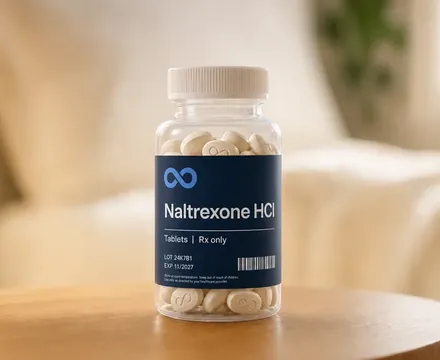
Naltrexone is often the most evidence-backed place to start. It blocks the opioid receptors involved in alcohol's rewarding buzz, so drinking feels less rewarding over time.
It's a 50 mg tablet taken by mouth, it isn't a controlled substance, and you can take it while you're still drinking. That makes it a natural fit for telehealth care.
For some people, a GLP-1 adds something naltrexone doesn't, especially when weight or blood sugar is also part of the picture. Our overview of GLP-1 medication for alcohol use covers who tends to be a good candidate.
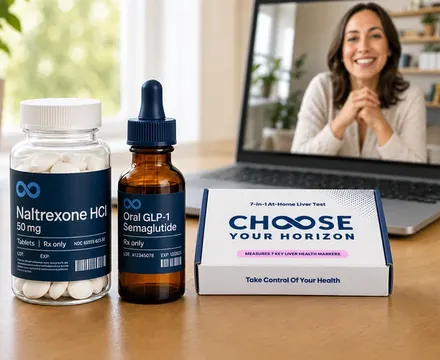
Choose Your Horizon offers a physician-guided GLP-1 and naltrexone combination for people who are a good fit for both. A physician reviews your history, decides what makes sense, and adjusts the plan as you go.
It's part of an integrated solution built on clinical, neurological, and behavioral science, with medication, coaching, and digital tracking working together. The medical team is led by a Mayo Clinic-trained psychiatrist.
Our guide to taking a GLP-1 and naltrexone together explains how the two work side by side.
Questions to Ask Before You Start
Whoever you choose, a few direct questions will tell you a lot.
Ask who prescribes. Get the name of the prescribing clinician and confirm they're licensed in your state.
Ask about screening. A good provider can explain exactly what they check before prescribing.
Ask about the pharmacy. Find out which pharmacy fills the prescription, and whether the medication is FDA-approved or compounded.
Ask about follow-up. Learn how often you'll hear from your clinician as your dose changes, and what happens if you have side effects.
Ask about cost. Get the full picture, including follow-up, and what isn't included.
A legitimate provider will answer all of these clearly. If you get vague answers or pressure to buy right now, that tells you something too.
Real Care Is Worth Looking For
Getting GLP-1 support for drinking online can work well when it's real medical care. That means a licensed clinician, honest screening, a licensed pharmacy, and follow-up that lasts as long as your treatment does.
Keep the evidence in perspective. GLP-1s are off-label for alcohol and still being studied, while naltrexone has been FDA-approved for alcohol use disorder for decades.
Use the FDA's red flags as a filter. If a seller skips screening, can't tell you who prescribes, or promises too much, keep looking.
Frequently Asked Questions
Can you get a GLP-1 for alcohol through telehealth?
Yes, a licensed clinician can prescribe a GLP-1 off-label through telehealth after an appropriate evaluation. A prescription depends on your health history and is never guaranteed.
Are GLP-1s FDA-approved for alcohol use disorder?
No. GLP-1s are approved for type 2 diabetes, weight management, and certain related conditions. Using them for drinking is off-label, while naltrexone has been FDA-approved for alcohol use disorder since 1994.
Do I have to stop drinking before an online assessment?
No. Many people start while they're still drinking. If you drink heavily every day, tell your clinician, since stopping suddenly can cause withdrawal.
Is compounded semaglutide safe to buy online?
Compounded drugs aren't FDA-approved, and the FDA has flagged fraudulent and mislabeled products. The FDA recommends FDA-approved medication from a state-licensed pharmacy unless a compounded version is medically necessary.
How do I know if a GLP-1 telehealth company is legitimate?
Look for a licensed prescriber you can reach, real screening before any prescription, a verifiable licensed pharmacy, and ongoing follow-up. Be wary of no-screening sales and prices that seem too good to be true.
Can a telehealth doctor prescribe naltrexone?
Yes. Naltrexone isn't a controlled substance, so a licensed clinician can prescribe it through telehealth after an appropriate evaluation.
If you're ready to explore medication support for your drinking, take the online Alcohol Use Assessment to see if naltrexone, or a physician-guided GLP-1 and naltrexone combination, is a good fit for you.
A private, physician-led plan to drink less or quit.
Medication, coaching and support from home. A short assessment is the first step.
Start Assessment