A 2 minute assessment to get a personalized mental health or alcohol recovery plan.

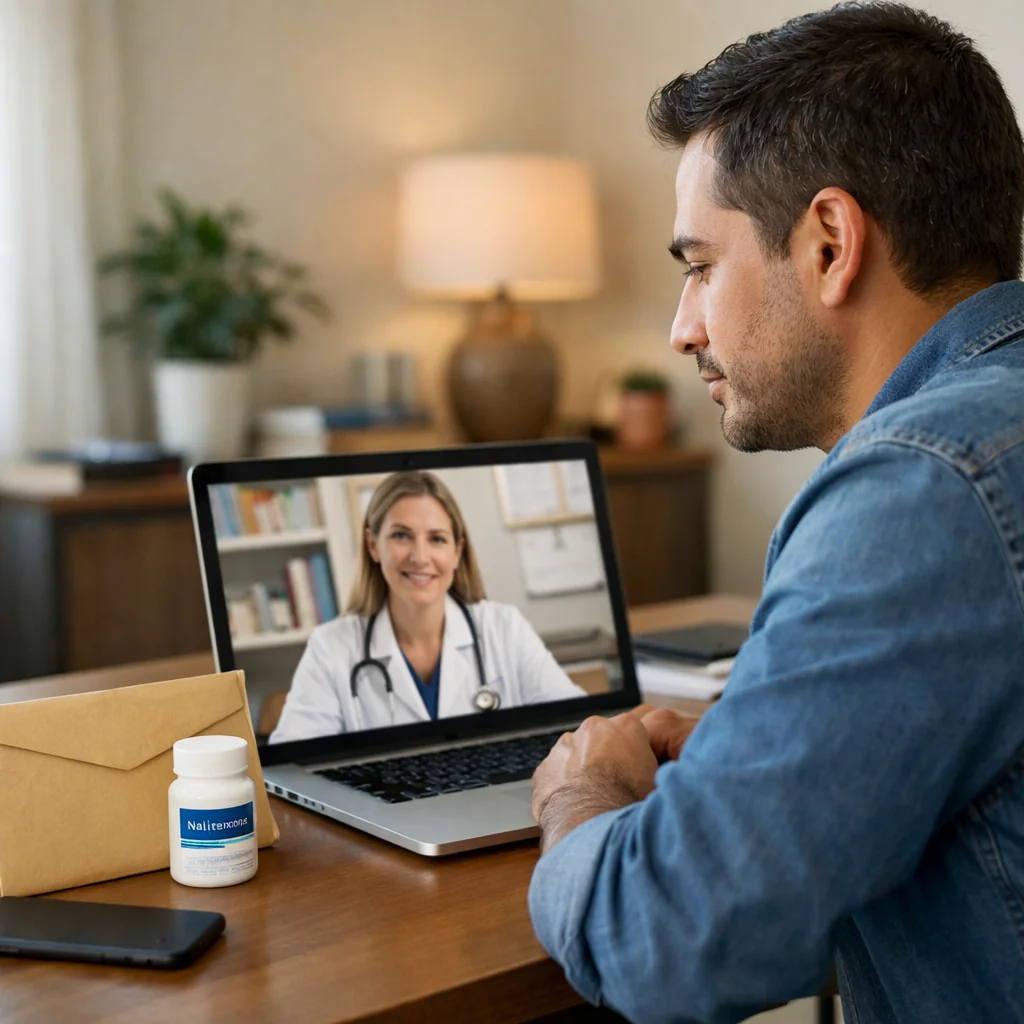
Private alcohol treatment means getting real, evidence-based help without waiting rooms, front desks, or anyone in your life needing to know.
What You'll Discover:
• What private, at-home alcohol treatment actually involves.
• How your privacy is protected at each step.
• How online care with naltrexone works from start to finish.
• Who confidential at-home care suits best.
• How an integrated online solution brings it all together.
Plenty of people want to drink less but stall at one quiet worry. They do not want to be seen walking into a clinic, sitting in a waiting room, or explaining themselves at a front desk.
That worry is reasonable, and it keeps a lot of capable people from getting help they would genuinely benefit from. The good news is that it is also solvable.
Private alcohol treatment exists precisely for this. It delivers the same evidence-based care, built around the medication naltrexone, without the exposure that makes traditional treatment feel risky.
Here is what it involves, how the privacy actually works, and who it fits.
None of this requires you to identify as having a problem or to use any particular label. It is simply care for people who want to change their relationship with alcohol, on their own terms.
What Private Alcohol Treatment Means
Private alcohol treatment is care for drinking less or quitting that happens discreetly, usually online and at home, rather than in a clinic or rehab facility. The point is to remove the visibility that stops people from starting.
It is not a watered-down version of real treatment. The clinical core is the same evidence-based approach a good doctor would use, including medications for alcohol use disorder like naltrexone.
What changes is the packaging around the care. No waiting room, no chart at the local clinic, no chance of running into someone you know. The treatment travels to you instead of the other way around.
That shift matters more than it sounds. For a working professional, a parent, or anyone in a small community, privacy is often the difference between getting help and putting it off for another year.
Consider how often the barrier is logistical rather than medical. The treatment is willing, the person is willing, and the only thing standing in the way is the prospect of being seen. Remove that, and the path opens.
It also changes how the decision feels. When no one has to know, the stakes of simply trying drop a lot. You can start, see how it goes, and keep it entirely your own business.
How Your Privacy Is Actually Protected
Privacy is the whole promise, so it is worth being specific about how it holds up. Several layers work together.
First, your health information is protected by law. Medical records and conversations are confidential and shared only with your care team, not employers, neighbors, or anyone else.
Second, there is no physical exposure. You never sit in a waiting room or sign in at a desk. The entire process happens through secure, private channels on your own device.
Third, the medication arrives discreetly. Naltrexone ships in plain packaging with nothing on the outside that announces what is inside. To anyone glancing at it, it is just a package.
Discretion is not a perk added on top here. It is built into how the care is designed, from the first assessment to the box on your doorstep.
You also control the pace of disclosure entirely. If you ever decide to loop in your regular doctor or a partner, that is your choice to make later, not a requirement to get started now.
That design choice reflects who actually seeks this kind of help. Many are high-functioning people with careers and families to protect, and the care is shaped around that reality rather than ignoring it.
How Online Care With Naltrexone Works
The mechanics are simpler than most people expect. Private at-home treatment usually follows a short, clear sequence.
It starts with an online assessment about your drinking and health history. From there a medical doctor reviews your information to decide whether naltrexone is a safe and appropriate fit for you.
Naltrexone itself is well understood. It is an oral 50mg tablet, FDA-approved for alcohol use disorder since 1994, that works as an opioid antagonist to mute the reward signal alcohol triggers in the brain.
If it is a fit, you receive a naltrexone prescription online and the medication ships to your door. You can take it daily or before drinking occasions, depending on your goal.
The follow-up is private too. Check-ins happen through messaging or video, so adjusting a dose or asking a question never means another trip anywhere.
This is not a fringe model. Research on telehealth-delivered care for alcohol use disorder finds that patients value the accessibility, including the removal of travel and the privacy it offers.
What the First Few Weeks Look Like
Knowing the shape of the early weeks helps the whole thing feel less abstract. Private care is designed to fit into a normal life, not take it over.
In the first week, most people simply start taking the medication and begin paying closer attention to their drinking. Naltrexone tends to show effects within the first few weeks, so there is no long waiting period before anything happens.
A common early experience is that the pull to keep drinking softens. The first drink no longer reliably leads to the second and third, and the urge that used to feel automatic starts to lose its grip.
People often describe this as feeling more in control rather than deprived. The choice to stop after one is suddenly easier, because the craving that used to override it is quieter.
You also are not left to interpret all of this alone. A care team is reachable for questions, dose tweaks, or just reassurance, all without an appointment on the calendar.
If something does not feel right, you say so and the plan adjusts. That responsiveness is part of what makes a remote model work as well as it does.
In-Person Care vs Private At-Home Care
Both can work. The table below compares them on the things people actually weigh when privacy is the deciding factor.
The privacy row is the one that usually decides it. For many people, the in-person version is not too clinical or too expensive, it is simply too visible.
The cost row deserves a note too. Inpatient programs can run many thousands of dollars, while at-home medication-based care often costs a fraction of that, sometimes less than a month of drinking.
The time row adds up quietly as well. Travel, parking, waiting, and time off work all carry a real cost, even when the appointment itself is brief. At-home care removes most of that friction.
Who Private At-Home Care Suits
This model is not for everyone, and it is honest to say so. People in severe alcohol withdrawal or with serious medical complications need in-person care first.
For a large group of people, though, private at-home care fits almost perfectly:
• Working professionals who cannot or do not want to take time off for appointments.
• People in small towns where anonymity at a local clinic is impossible.
• Anyone who wants to drink less without announcing it to family or coworkers.
• People who have put off help purely because of how it would look.
If you see yourself in that list, the privacy barrier was probably never about the care itself. It was about exposure, and that is exactly what this model removes.
It is worth saying plainly that wanting discretion is not the same as being in denial.
People protect their privacy for sound reasons, including jobs that involve security clearances, licenses, or simply a preference to keep personal matters personal.
Evidence supports the reach of this approach too. Reviews of telemedicine for substance use care show it can expand access for people who are remote, busy, or reluctant to seek in-person help.
There is also a quieter group this suits, the people who do not feel they have a serious problem yet but would like to drink less before it becomes one. Private care lets them act early without any label attached.
Acting early is underrated. The same care that helps someone cut back hard also works for someone who just wants their drinking to stay where they want it, and starting sooner is almost always easier than starting later.
Privacy Without Going It Alone
One worry about private care is that discretion might mean isolation. In practice, the opposite is true. You can keep your privacy and still have real support behind you.
The medication handles the biology of craving. Coaching and check-ins handle the human side, the triggers, the habits, the rough weeks. Together they cover far more than a prescription alone.
That is the idea behind treating more than the surface. The drinking is what shows, but the stress and patterns underneath it are what a fuller plan addresses.
That blend matters because drinking is rarely just chemical. Stress, routine, and the small rituals of a hard day all play a role, and a care plan that ignores them tends to fall short.
So privacy here does not mean doing it by yourself. It means choosing exactly who is involved, which is your care team, and no one else.
For many people, that controlled circle is what finally makes help feel possible. The support is real, the privacy is real, and you decide where the line sits.
The Choose Your Horizon Integrated Solution
Choose Your Horizon is built around exactly this need. It brings naltrexone, physician care, and coaching together into one private, integrated solution that runs entirely online.
A real medical doctor reviews your history and prescribes when appropriate, grounded in clinical, neurological, and behavioral science. You are not navigating this alone or guessing at doses.
This kind of telehealth care for alcohol is available across all 50 states, and the medication ships discreetly in plain packaging. There is no clinic to visit and no schedule to rearrange.
If you want the basics on the medication first, our overview of what naltrexone is and how it works is a good place to start.
The goal is your goal. Whether you want to drink less or stop entirely, the support adjusts to you, with your privacy and your autonomy kept fully intact.
That flexibility is part of the design. There is no single required outcome, no pressure toward a goal you did not choose, and no judgment if your aim shifts along the way.
Frequently Asked Questions
Is private alcohol treatment confidential?
Yes. Your health information is protected by privacy law and shared only with your care team. There are no waiting rooms, and medication ships in discreet, unmarked packaging.
Does at-home alcohol treatment actually work?
It uses the same evidence-based care as in-person treatment, built around naltrexone. Research on telehealth for alcohol use finds patients value the access and that virtual care can be effective.
Will my employer or insurance find out?
Your treatment is private medical information. It is not reported to your employer. Whether anything touches insurance depends on how you choose to pay, and discreet self-pay options exist.
Who should not use private at-home care?
Anyone experiencing severe alcohol withdrawal or serious medical complications should seek in-person care first. A prescribing physician helps determine whether at-home care is safe for you.
Can I get private alcohol treatment in any state?
Care through Choose Your Horizon is available across all 50 states. You begin with an online assessment, and everything that follows happens remotely.
Do I need to stop drinking before I start?
Not necessarily. Naltrexone is often taken while you are still drinking, since that is how it helps reduce cravings over time. A prescribing physician will confirm the right approach for your situation.
Help That Respects Your Privacy
Wanting help and wanting privacy are not in conflict. Private alcohol treatment lets you have both, with real, evidence-based care that never requires you to be seen seeking it.
For a long time those two things did feel like a trade-off. They no longer have to be.
No waiting rooms, no local records, no announcements. Just a discreet assessment, physician-guided care, and naltrexone delivered to your door if it is the right fit.
The care meets you where you already are, at home, on your schedule, in your own time. That is what makes it possible to start today instead of someday.
If privacy has been the thing holding you back, this is the model built for you, with your autonomy front and center. To see whether it fits, take the online Alcohol Use Assessment and find out if naltrexone could be a good fit for you.