A 2 minute assessment to get a personalized mental health or alcohol recovery plan.


Kids notice earlier and more often than parents expect. Here is how to talk about a change in your drinking honestly, at the right level of detail, without turning it into a confession scene.
What You'll Discover:
• What children actually notice about a parent's drinking at each age.
• How much honesty is right for a toddler, a school-age kid, and a teenager.
• What to say when they ask why you stopped.
• The four things that reliably backfire with kids.
• How to model a different relationship with alcohol day to day.
• When it makes sense to bring in more support for the family.
Most parents who change their drinking assume the hard part is the drinking. Then a seven-year-old says something at breakfast and it turns out the hard part is the conversation.
Children track routines with unnerving accuracy. They may not have words for what they noticed, but they noticed.
The good news is that this conversation is far smaller than it feels from the inside. It does not require a speech, a label, or a full accounting of your history.
It requires a few true sentences pitched at the right age, and then a year of them watching you.
What Kids Actually Notice
Kids rarely clock the alcohol itself. They clock the pattern around it.
The glass that appears at the same time every evening. The tone shift after the second one. The difference between the parent who reads at bedtime and the parent who is suddenly too tired.
Younger children register mood and availability. Older ones register the object, the amount, and eventually the reason behind it.
By nine or ten, most kids have a working theory. It is almost always less accurate and more self-blaming than the truth, which is exactly why saying something out loud helps.
That is the real argument for having the conversation. Not confession, and not absolution. Just replacing a theory they invented with a fact they can hold.
The Age-by-Age Version
The detail changes with age. The honesty does not.
Toddlers and Preschoolers
Under five, skip alcohol entirely and explain the change they can feel.
"I have more energy now" and "I am not as grumpy at bedtime" are complete, true, and age-appropriate. That is the whole conversation.
If they ask about the glass, "that is a grown-up drink and I decided not to have it anymore" covers it. They will move on much faster than you will.
School Age
Somewhere between six and ten, kids start understanding alcohol as a category and noticing who has how much of it.
This is the age where one calm sentence does more good than anything else you could say. "Alcohol was not making me feel good, so I stopped drinking it."
If they ask whether it is bad, be accurate without being frightening. It is not great for bodies, some adults drink it and some do not, and you decided not to.
Kids this age also need to hear one specific thing out loud: that none of it was about them. Most of them will not ask, and a surprising number are quietly wondering.
Tweens
Eleven to thirteen is when kids start comparing families. They know which parents have a drink at soccer games and which ones do not.
At this age you can be more direct about the reasons. Sleep, mood, how you felt in the mornings, wanting to actually be there in the evenings.
They may test you with a follow-up about whether you had a problem. Answering plainly beats deflecting, because deflection tells them the topic is dangerous and ends the conversation for good.
Teenagers
Teenagers have already formed a view. They have seen more than you think and remember more than you would like them to.
With them, honesty is the only thing that works. Vagueness reads as dishonesty, and dishonesty is the one thing that closes the door.
Be specific about what changed and why. Skip the graphic details, and skip anything that makes them responsible for managing your feelings about it.
The National Institute on Alcohol Abuse and Alcoholism's guide to talking with your child about alcohol is built for roughly this age range and worth reading alongside your own conversation.
The Line Between Honest and Too Much
The rule of thumb is short. Tell them what is true, at the level of detail that helps them, and then stop talking.
Children do not need your worst nights. They do not need the fights, the numbers, or the fear you were carrying.
What they need is a story with no gaps in it. Gaps get filled with self-blame, every single time.
Oversharing puts a child in the position of comforting a parent, which is a job they are not built for. Under-explaining leaves them managing a mystery on their own.
Aim for the middle. Honest, calm, brief, and finished.
What to Say When They Ask Why You Stopped
The question tends to arrive without warning, usually in a car or a checkout line, delivered in the flat tone kids use for enormous questions.
A version that works at almost any age above six: "I noticed alcohol was making me feel worse instead of better, so I stopped. I feel a lot better now."
Three things make that sentence work. It is true, it assigns no blame, and it does not invite a follow-up they are not equipped to handle.
If they push, add one layer of specificity rather than a paragraph. Bad sleep, low mood, wanting to be more present after dinner.
Our guide on how to tell someone you quit drinking covers the adult version of this, and most of it translates down.
Four Things That Reliably Backfire
A few well-meant moves cause more trouble than the silence they were meant to fix.
• Promising "I will never drink again" when you are not certain. A broken promise lands harder on a kid than an honest change ever would.
• Making them a monitor. Asking a child to watch your drinking hands them a job no child should have.
• Framing it as something you did for them. That quietly makes them responsible for keeping it going.
• Denying something they clearly saw. Contradicting a real memory teaches a kid not to trust their own read on a room.
If they bring up something specific from before, acknowledge it. "You are right, that happened, and I am sorry" closes a loop that silence keeps wide open.
Apologies work best when they are short and not followed by explanation. The explanation is for you, and they did not ask for it.
Modeling a Different Relationship With Alcohol
The conversation matters less than what your kid watches you do over the following year.
NIAAA's guidance on parenting to prevent childhood alcohol use emphasizes that parents shape attitudes through everyday modeling and regular low-stakes conversations, not through one big talk.
Practically, that looks like ordering something you actually want at dinner instead of a resigned glass of tap water. It looks like getting through a bad day without reaching for anything.
It also looks like being genuinely unbothered when other adults drink around you. Kids read a parent's discomfort as a signal that a topic is dangerous.
The version of this that sticks is boring on purpose. Nothing to perform, nothing to announce, just a parent who is more available at 7pm than they used to be.
Why This Matters More Than It Feels Like It Does
Research on the effect of parental drinking on adolescents found that in nearly two of every three published associations, parental drinking was significantly linked to a child harm outcome.
Adolescent drinking behavior was the most commonly measured outcome in that body of work, and other outcomes were studied far less often.
Other work on parental problem drinking and parenting points to parenting behaviors as part of the pathway between a parent's drinking and a teenager's own alcohol use.
None of that is here to frighten anyone, and guilt is not a useful parenting tool. The takeaway worth keeping is the reverse of the scary one.
If your drinking was influencing your kids, your change is influencing them too. Influence runs in both directions, and the second direction starts the day something shifts.
When Wine Culture Is the Background Noise
Parents cutting back run into a specific complication. Alcohol is woven into how parenting gets joked about, talked about, and survived.
The playdate glass. The group chat memes. The school auction wine pull, which is somehow always a wine pull.
We wrote about this in our piece on mommy wine culture, and the short version is that the jokes are load-bearing for a lot of households.
Your kids absorb that culture too, well before they can evaluate it. Being visibly fine without a drink does more work on that than any conversation would.
You are not obligated to fight any of it publicly. Nobody has to win an argument at a birthday party.
When to Bring In More Support
Sometimes the conversation with your kid turns out to be the easy part, and the adults are the harder one.
If your household or extended family drinks heavily, changing your own pattern can create friction that children pick up on immediately. Our article on being sober in a drinking family walks through that dynamic.
If a partner's drinking is part of the picture, that is worth addressing directly rather than around. Our guide to alcohol and relationships covers how those conversations usually go and where they get stuck.
Family therapy is worth considering when children seem visibly anxious, when the drinking involved fear or unpredictability, or when a teenager has quietly stopped talking to you about any of it.
Where Medication Support Fits
Plenty of parents find the conversation gets easier once the drinking itself has.
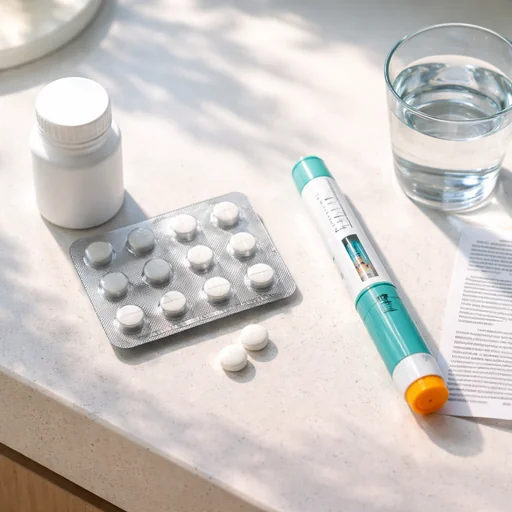
Naltrexone is an oral 50mg tablet that reduces alcohol cravings by blocking the reward signal that reinforces drinking. It is prescribed for people who want to stop completely and for people who simply want to drink less.
The practical benefit for a parent is narrow and useful. The 6pm pull gets quieter, which turns the evening routine back into an evening instead of a negotiation you have to win while making dinner.
The Bottom Line
Your kids already noticed something. A short, honest sentence turns a mystery into a fact, and facts are much easier for children to carry than mysteries.
Match the detail to the age. Leave out your worst nights. Do not make them responsible for the change, or for keeping it going.
Then let the next several months do the actual talking. What they watch you do will outrank anything you say to them at a kitchen table.
And if you are worried you waited too long, that worry is nearly universal among parents who change something. Kids are considerably more interested in what happens next than in what already happened.
Frequently Asked Questions
Should I tell my kids I quit drinking?
In most cases yes, in an age-appropriate way. Children usually notice a change, and they fill silence with their own explanations, which tend to be harsher than the truth.
At what age should I explain alcohol to my child?
Simple explanations work from around five or six. More detailed conversations fit best from about age ten onward, which is the range NIAAA's parent guidance is built for.
What if my child uses the word "alcoholic"?
Answer plainly, without handing them a label. Something like "alcohol was becoming a bigger part of my life than I wanted, so I changed it" is honest and gives them something they can actually process.
Will my drinking affect my child's future drinking?
Parental drinking has been linked to adolescent drinking across a large body of research. Changing your own pattern and talking about it openly are two of the most useful things a parent can do.
Should my kids ever see me drink?
That is a personal call, and there is no single right answer. Consistency matters more than the presence of a glass, because children read the relationship you have with alcohol rather than the object itself.
What if my child is angry about how I used to drink?
Let them be angry and do not argue with the memory. Acknowledging it plainly, apologizing once, and then being reliably different is what actually resolves it over time.
If the drinking itself is the hard part, that is worth getting real support with. Take the online Alcohol Use Assessment to see whether naltrexone and Choose Your Horizon's integrated solution could fit your situation.