A 2 minute assessment to get a personalized mental health or alcohol recovery plan.


Billable hours, client dinners, and work built around conflict all keep alcohol within easy reach. Research shows attorneys screen positive for risky drinking more often than other professionals. That says something about the conditions, not about who lawyers are.
What You'll Discover:
• What the landmark 2016 study of nearly 13,000 attorneys actually found.
• Why the early career years carry the most risk.
• How billable hours, client entertaining, and adversarial work feed the pattern.
• What a hangover does to the exact skills legal work depends on.
• How confidential help generally works, including lawyer assistance programs.
• Where private, physician-guided care fits around a legal career.
The legal profession has a long and fairly open relationship with alcohol. Firm happy hours, client dinners, closing celebrations, and the bottle that lives in a partner's credenza.
Most lawyers who drink are doing fine. But the profession's own research says the conditions around legal work make risky drinking more common than in most other fields.
That is not an accusation. It is useful information, and it points toward fixes that are more practical than most people expect.
So, here is what the research found, the pressures behind it, and what tends to help. Along the way, we take an honest look at the confidentiality questions that keep so many attorneys quiet.
What the 2016 Attorney Study Actually Found
Nearly every statistic you will see about lawyers and drinking traces back to one study.
In 2016, researchers backed by the Hazelden Betty Ford Foundation and the American Bar Association's Commission on Lawyer Assistance Programs published a survey of 12,825 licensed, employed attorneys.
The headline finding: 20.6 percent screened positive on the AUDIT, a standard 10-question tool, for drinking that was hazardous, harmful, or consistent with possible dependence.
For comparison, the authors noted that 11.8 percent of a broad, highly educated workforce screened positive on the same measure. So attorneys came in at nearly double.
You will also see 36.4 percent quoted. That number comes from the AUDIT-C, a shorter three-question version that looks only at how much and how often someone drinks.
Both figures are real. They just measure different things, which is why articles that use them interchangeably tend to confuse people.
The same survey found mild or higher symptoms of depression in 28 percent of respondents, anxiety in 19 percent, and stress in 23 percent. Drinking and mental strain tended to travel together.
Two caveats matter. A positive screen is a flag worth paying attention to, not a diagnosis. And because recruitment ran through bar association channels, the researchers could not calculate an overall participation rate.
Why the Early Career Years Carry the Most Risk
The most striking pattern in the study was not about the profession as a whole. It was about timing.
Attorneys aged 30 or younger had higher AUDIT scores than their older peers. Those in their first 10 years of practice had the highest rate of problematic use, at 28.9 percent, and the rate declined with experience.
Inside private firms, junior associates had the highest rates. Senior associates came next, then junior partners, then senior partners.
Here is the detail that reframes the whole conversation. Among attorneys who said their drinking had been a problem at some point, 44 percent said it began within their first 15 years of practice.
Only 26.7 percent said it started before law school.
That points away from the idea that law attracts heavy drinkers. It points toward the conditions of early practice: long hours, little control over your time, high stakes, and constant pressure to prove you belong.
The Pressures Built Into Legal Work
Plenty of careers are demanding. Legal work combines a few specific pressures that make alcohol unusually easy to reach for.
The billable hour. When your life is measured in six-minute increments, the workday has no natural end. A drink becomes the line between work and everything else, because nothing else draws that line for you.
Client entertaining. Business development often happens over dinner and a wine list. Declining a drink can feel like declining the client, and keeping pace can feel like part of the pitch.
Adversarial stress. Your job is to anticipate the worst outcome and argue against someone who wants it. That kind of vigilance is a professional skill, and it does not switch off at the front door.
Always on. Email at 11 p.m., a motion due Monday, a partner who expects an answer tonight. Rest starts to feel like something you have to manufacture.
A 2021 follow-up study of 2,863 lawyers in California and Washington, D.C. tested which workplace factors mattered most.
Overcommitment to work and workplace permissiveness toward alcohol were tied to the highest likelihood of stress and risky drinking, for men and women alike.
That is a genuinely useful finding, because both of those are things a person, a team, or a firm can actually change.
The depletion that builds from this kind of schedule has a name, and we cover it in our article on alcohol and burnout.
If you run your own practice, the pressures overlap heavily with what we describe in our piece on entrepreneurs and drinking, where the business never really closes for the night.
What a Hangover Does to the Skills Legal Work Runs On
Legal work runs on sustained attention and memory for detail. Those happen to be the skills a hangover takes first.
A systematic review of the next-day effects of heavy drinking pooled 19 studies with 1,163 participants. Its meta-analysis found impairments in short-term memory, long-term memory, sustained attention, and psychomotor speed the next day.
The key detail is that these effects showed up once blood alcohol was back near zero. You can be fully sober and still running at a noticeable deficit.
Now map that onto a normal week. Reading a 90-page agreement for the one clause that changes everything. Holding a timeline in your head through a deposition. Catching the inconsistency in a witness statement on the third pass.
None of those tasks are forgiving of a foggy morning. And none of them come with a warning light when your attention drifts.
We dig into the wider picture in our guide to alcohol and work performance, including the small, cumulative costs that rarely show up as one bad day.
The Pressure vs. the Healthier Response
Small Changes That Work in a Legal Week
Most advice about drinking less assumes you control your calendar. Associates rarely do, so the changes that stick tend to be small and specific.
Start with the moment that is most automatic. For many attorneys, that is the first drink after a long day, poured almost before the bag hits the floor.
Replace the drink, not the ritual. Keep the pause, the chair, and the decompression, and put something else in the glass for two weeks.
At client dinners, order first. Whatever you order sets the pace for the table, and almost nobody tracks what the host is drinking as closely as the host fears.
All that said, track what you actually drink for two weeks. The total is usually more useful than any rule you could set for yourself in advance.
Why So Many Lawyers Stay Quiet
The 2016 study did something most prevalence research skips. It asked attorneys what stopped them from getting help.
Among those who had sought treatment, the two most common barriers were not wanting others to find out (50.6 percent) and concerns about privacy or confidentiality (44.2 percent).
Attorneys who had never sought treatment named the same two barriers most often.
That fear makes sense. Reputation is a lawyer's working capital, and nobody wants their judgment questioned by a partner, a client, or opposing counsel.
So it deserves a straight answer rather than blanket reassurance.
In general terms, getting medical care from a licensed clinician for your own health is a private medical matter. It is generally treated as confidential health information, the same as the rest of your medical care.
What you may be asked to disclose elsewhere is a separate question. Bar applications, malpractice insurance forms, and firm policies each have their own rules, and those rules vary by state, jurisdiction, and employer.
This is not legal advice, and no article can tell you how a specific rule applies to you. If you need certainty, read the exact question or policy in front of you, or ask a confidential resource that knows your jurisdiction.
If you are a law student or bar applicant, character and fitness questions differ from one jurisdiction to the next. Read the current version for yours rather than relying on what a classmate heard.
Lawyer Assistance Programs, in General Terms
Most states have a lawyer assistance program, usually run through the state bar or an affiliated organization.
In general, these programs offer confidential peer support, assessments, and referrals for lawyers and judges. Many also serve law students, and some offer short-term counseling at no cost.
They are generally built around confidentiality. In fact, the authors of the 2016 study specifically urged the profession to publicize that confidential nature more widely, because so many attorneys did not know about it.
Each program sets its own policies, though. Before you share details, it is reasonable to ask how they handle confidentiality and what, if anything, they would ever report.
Private Care That Fits a Billable Schedule
A lot of traditional care asks for weekly appointments during business hours. For someone billing 2,000 hours a year, that alone can end the conversation before it starts.
Then there is the waiting room. In a small legal market, the odds of running into someone you know are not zero.
Online care strips most of that friction out. Consultations happen by message on your schedule, a physician reviews your history, and medication ships to your door in discreet packaging.
No referral, no employer involvement, and no time away from the office. Our overview of private alcohol treatment explains how discretion works in practice.
Where Naltrexone Fits
You do not need to adopt a label or wait for a crisis to get help. Wanting more control over your drinking is reason enough.
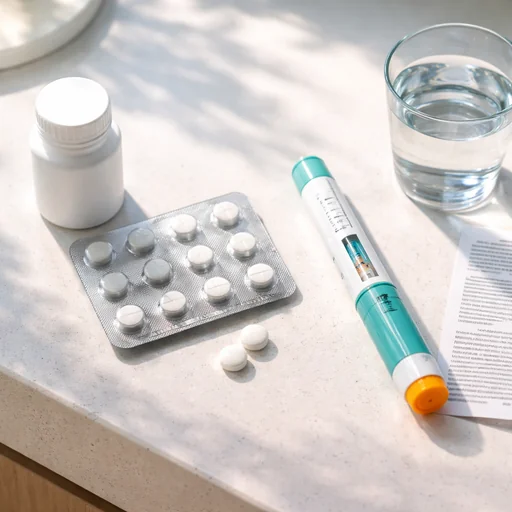
Naltrexone is an oral medication, typically a 50mg tablet, FDA approved for alcohol use disorder since 1994. It is an opioid antagonist that blocks the mu-opioid receptor, which dampens the reward signal alcohol produces in the brain.
In practice, drinking stops delivering the same payoff. The second and third glass lose much of their pull, which is usually where a client dinner turns into a lost morning.
Some people take it daily. Others take it about an hour before an event where drinking is likely, like a firm party or a client dinner, as their physician advises.
It works for people aiming to cut back and for people aiming to stop. It is not habit-forming, and most people notice a difference within 2-4 weeks.
Of course, your prescriber reviews your history first, including any current opioid use, since naltrexone and opioids do not mix. A physician-guided plan can include other options when they fit, such as a GLP-1 medication in some cases.
If you drink heavily every day, talk to a clinician before stopping suddenly, because alcohol withdrawal can be serious. Seek emergency care for confusion, seizures, or hallucinations.
At Choose Your Horizon, naltrexone is one part of an integrated solution that pairs medication with coaching and ongoing support, grounded in clinical, neurological, and behavioral science.
The Bottom Line for Lawyers Who Drink
The research is clear that attorneys screen positive for risky drinking more often than other professionals. It is just as clear that the risk concentrates in the early years and in workplaces that normalize overwork.
That makes this a story about conditions. And conditions can change, one shutdown ritual and one client dinner at a time.
The biggest barrier is usually not motivation. It is the fear of being seen. Private, physician-guided care exists precisely so that fear does not get the final say.
You do not need a crisis to qualify for help. Wanting to feel sharper, sleep better, and stay in control is reason enough.
Frequently Asked Questions
Do lawyers really drink more than other professionals?
A 2016 study of 12,825 attorneys found 20.6 percent screened positive for hazardous or harmful drinking, compared with 11.8 percent in a broad, highly educated workforce. Rates were highest among younger attorneys.
Why are younger lawyers at higher risk?
Attorneys in their first 10 years of practice had the highest rates. Most who reported a drinking problem said it began after they started practicing, which points to early-career conditions like long hours and little control.
What is a lawyer assistance program?
Most states have one. They generally offer confidential peer support, assessments, and referrals for lawyers, judges, and often law students.
Will getting help for drinking affect my law license or bar admission?
Rules vary by state, jurisdiction, and employer, so no article can answer this for your situation.
Getting medical care is generally treated as a private health matter, and a confidential assistance program can help you understand the rules where you practice.
Can I take naltrexone and still go to client dinners?
Yes, many people do. Taken about an hour before drinking, naltrexone blunts the reward of alcohol, so it becomes easier to stop after one or two.
Is online alcohol treatment confidential?
Care from licensed clinicians is generally treated as confidential health information. With Choose Your Horizon, consultations happen online and medication ships in discreet packaging.
Find out whether naltrexone could fit the way you work. Take the online Alcohol Use Assessment privately, on your own schedule, in a few minutes.