A 2 minute assessment to get a personalized mental health or alcohol recovery plan.

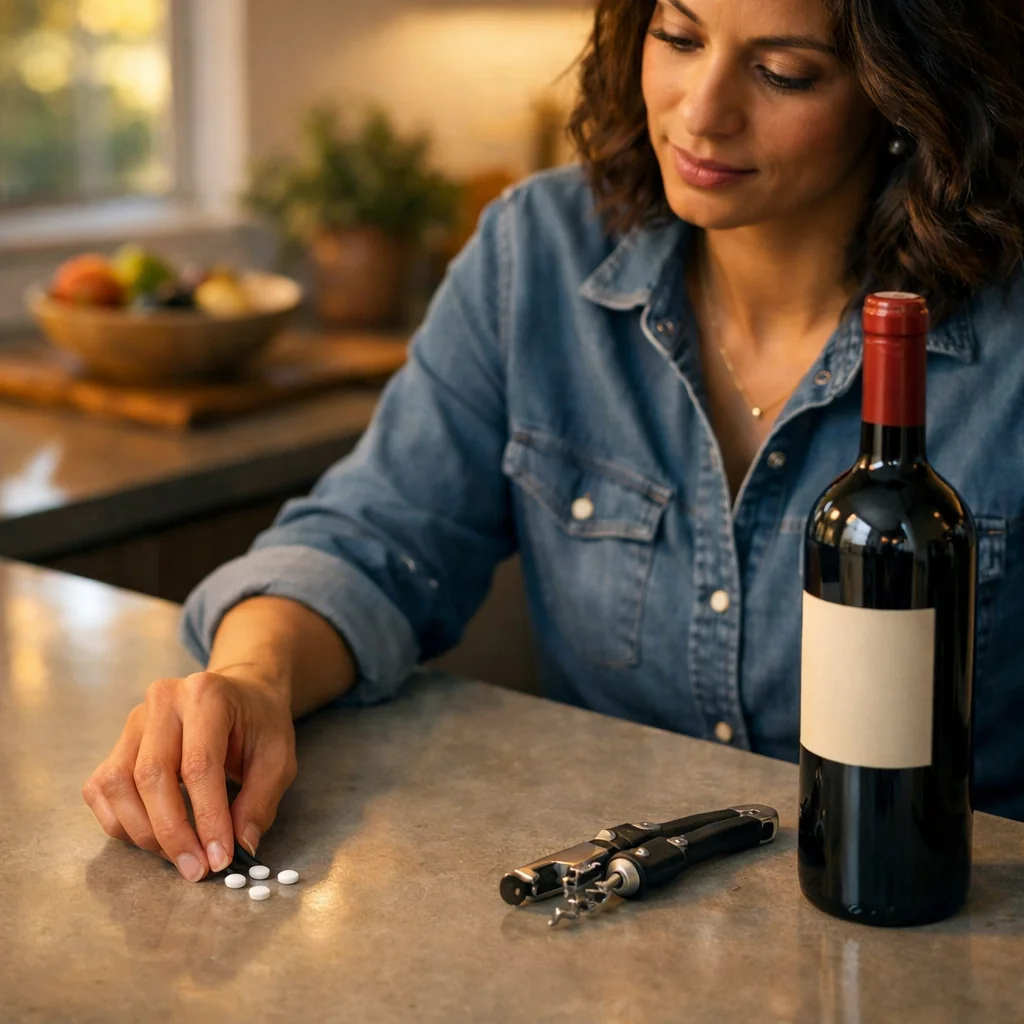
If the evening glass of wine has quietly become most of the bottle, the issue is not really appetite. It is a ritual wired to a reward, and naltrexone works on both.
What You'll Discover:
• Why a nightly glass is worth a look, even without a label.
• Why the nightly glass of wine becomes so automatic.
• How naltrexone dials down the pull of that first pour.
• Daily dosing versus taking it before you drink.
• What to expect week by week on naltrexone.
• Wine-specific ways to loosen the ritual, not just the habit.
There is a certain hour. The workday winds down, dinner is in motion, and almost without deciding, you reach for the corkscrew.
The first glass feels earned. The second feels natural. By the time the bottle is light, you are not even sure you tasted the last pour.
If that rhythm sounds familiar, you are far from alone. Nightly wine has a way of turning from a treat into a fixture so gradually that you barely notice.
Here is the reassuring part. This is not a willpower gap or a secret character flaw. It is a habit riding on a reward loop, and both of those respond to the right tool.
Does the Nightly Glass Even Count
A lot of people wait to take their drinking seriously until it looks dramatic. A missed morning, a scary night, a number flagged on a chart. Nightly wine rarely trips those alarms.
So the quiet daily glass gets a pass. It feels ordinary, social, even a little earned. That is exactly why it can grow for years without ever raising a flag.
Here is the part worth hearing. You do not need a label or a rock-bottom story for this to be worth a look. If the pour has gone automatic, that alone is reason enough.
The honest test has nothing to do with how much you drink or what anyone would call it. It is whether the nightly glass has more say over your evening than you would like.
Plenty of people who look after themselves in every other way still watch the wine creep upward. That does not make you a problem drinker. It makes you human, with a habit worth tending.
Why "Wine O'Clock" Sticks So Hard
Wine o'clock is powerful because it is two things at once. It is a ritual and it is a reward, stacked on top of each other.
The ritual is the cue. A time of day, a hard afternoon, the sound of the fridge door. Your brain has learned that this moment means wine.
The reward is what keeps it locked in. That first glass brings a little wave of relief and warmth, and your brain files it away as something to repeat.
Over months, the two fuse together. The cue arrives and the craving follows before you have consciously chosen anything.
For a lot of people the cue is stress. Wine becomes the thing that marks the border between the demands of the day and the rest of the evening.
There is also a slow creep. As tolerance builds, one glass stops doing what it used to, so the pour quietly grows to hold the same feeling.
Add a culture that jokes about needing wine to survive the week, and the whole pattern feels normal even as it deepens.
That is why "just have less" so rarely works on its own. You are not fighting a single decision, you are fighting a groove worn in by hundreds of evenings.
We dig into that pattern more in our piece on the wine o'clock habit, including why evenings are the hardest time to hold a limit.
When Wine Is Doing an Emotional Job
Often the glass is not really about the wine. It is about the job the wine is doing for you, and that job is worth naming honestly.
For many people the evening pour is how they decompress. It marks the end of being on, the switch from other people's needs back to their own.
For others it takes the edge off something harder. Stress, loneliness, or a low hum of anxiety that gets loudest once the house finally goes quiet.
When wine is carrying that weight, willpower is the wrong tool. You are not trying to resist a drink, you are trying to meet a need that has only ever had one answer.
This is where naltrexone helps in a quieter way. As it turns down the reward, the wine stops being the automatic fix, which leaves room to find gentler ones.
A short walk, a hot shower, ten minutes of doing nothing at all. None of these are as fast as a pour, but with the reward muted, the pour stops winning by default.
How Naltrexone Dials Down the Pull of the Glass
Here is where the reward side of the loop becomes the opening.
Naltrexone is a once-daily 50mg tablet that works by blocking the reward alcohol produces in the brain. When that reward is muted, wine stops delivering its usual little payoff.
That matters most with the first glass. Normally a single pour of wine quietly increases the urge for the next, which is how one glass becomes three.
With naltrexone in your system, that priming effect is softened. The first glass feels more like a full stop and less like a starting gun.
You still taste the wine. You still get the flavor and the small ceremony of the pour. What fades is the tug that used to pull you back to the bottle.
This is why naltrexone helps whether your wine is a nightly habit or a weekend one. It is working on the reward, not on your resolve.
Over time this does something quietly powerful. Each evening you drink with the reward blocked, the old cue-and-craving groove gets a little shallower.
The cravings tend to ease week by week, which we explain in does naltrexone stop alcohol cravings. The habit starts to lose the fuel that kept it running.
Daily Dosing or Taking It Before You Drink
There are two common ways wine drinkers use naltrexone, and both are reasonable.
The first is daily dosing. You take one 50mg tablet at the same time each day, so the medication is always working whenever wine o'clock arrives.
A single dose stays active for about a day, so daily use means you are never caught without it. For a nightly habit, that steadiness is often the simplest path.
The second is targeted dosing. You take naltrexone about an hour before you expect to drink, so it is working the moment the first glass is poured.
Targeted dosing suits people whose drinking is more occasional or planned. For a true nightly ritual, many people find daily dosing easier to keep up.
The logic behind before-drinking dosing is worth understanding. Each time you drink with the reward blocked, the brain files wine under less of a payoff, so the pull fades a little more.
That is the idea at the center of the Sinclair Method. The medication and the wine have to overlap, so you take the tablet, wait about an hour, then drink as usual.
Skip the wine on a given night and, on the targeted plan, you skip the tablet too. Drink without it, and that evening does not do the quiet retraining work.
Studies that combined daily and before-drinking dosing found the approach reduced heavy drinking, which shows there is real flexibility here.
Whichever you choose, you do not have to decide alone or forever. Plenty of people start daily for the consistency and adjust later with a clinician.
Timing is the one thing worth getting right either way. We break it down in the best time of day to take naltrexone, and the Sinclair Method dosing recommendations cover the before-drinking approach in detail.
What a Wine Night Looks Like With Naltrexone
The clearest way to see the difference is to compare a typical evening with and without the medication working in the background.
None of this depends on you white-knuckling through the night. The change comes from the reward being turned down, not from sheer resolve.
What to Expect, Week by Week
It helps to know the shape of the change so you can judge it fairly. Naltrexone is a slow, steady shift rather than a switch.
The very first days are mostly uneventful. Some people feel a little queasy or tired as their body settles, and that usually eases within a week or so.
In the first week or two, many people notice the first glass is less satisfying, and the urge for the second is a little quieter than usual.
By around weeks three and four, the nightly pull often feels noticeably weaker. Some evenings you may forget to pour at all.
Over a couple of months, plenty of people find the bottle lasts far longer than it used to, or that some nights pass without wine entirely.
This is the habit unwinding in slow motion. Because the reward keeps going unrewarded, the brain gradually stops expecting it.
It also helps to track it. Noticing that a bottle now lasts three nights instead of one is the kind of proof that keeps you going.
Working does not have to mean zero wine. It means the pull is smaller, the stopping is easier, and the bottle lasts longer than it used to.
Progress is rarely a straight line. A stressful week can bring the old pull back, and that is normal, not a failure. The medication keeps working underneath it.
What the Nightly Bottle Quietly Costs
Part of what makes the nightly glass worth a second look is what it quietly takes while it gives.
Wine hides its calories well. A generous pour runs north of a hundred calories, and most of a bottle across a week is a stack of them your body never asked for.
Then there is sleep. Wine can help you drop off faster and then fray the back half of the night, the deep and dreaming stretches that actually restore you.
That is why a bottle-a-week habit can leave you tired in a way more sleep never quite fixes. The rest is there in hours, but not in quality.
None of this is meant to scare you. It is just the quiet arithmetic running under the ritual, the part that is easy to miss when the pour feels so normal.
When the pull comes down and the pours get fewer, this is what tends to return first. Clearer mornings, steadier energy, and sleep that finally lands.
Wine Is a Ritual, Not Just a Drink
Because so much of wine o'clock is ritual, it helps to give the ritual somewhere else to go.
The reach for the glass is often really a reach for a signal that the day is done. You can keep that signal and change what fills it.
A few small swaps tend to help alongside the medication:
• Pour something you enjoy into the same favorite glass, alcohol-free.
• Keep the wind-down cues, the music, the couch, the pause, and drop only the wine.
• Move the trigger if you can, with a short walk or a shower at the usual hour.
• Buy a nicer alcohol-free option so the substitute feels like a treat, not a punishment.
These are not about willpower either. They work by giving the ritual a new ending while naltrexone quiets the reward behind it.
The first few nights of a swap can feel a little thin, like something is missing. That fades faster than people expect, usually once the new ending starts to carry the same meaning.
The goal is not a barren evening. It is an evening that still feels like yours, minus the part that was starting to cost you.
Together, the two sides add up. The medication lowers the pull, and the new ritual fills the space the wine used to hold.
Conclusion
If the nightly glass has crept into a nightly bottle, it does not mean you lack discipline. It means a ritual and a reward have fused into a groove.
Naltrexone works on the reward, softening the pull of that first pour so stopping at one or two stops feeling like a battle. Whether you take it daily or before you drink, the effect builds over weeks.
Pair that with a gentler evening ritual, and wine o'clock slowly loses its grip. You are not white-knuckling anything. You are letting the habit fade the way it formed, a little at a time.
You do not have to wait until it feels like a crisis. Wanting your evenings back is a good enough reason to look into it.
Frequently Asked Questions
Will naltrexone stop me from enjoying wine at all?
No. You still taste the wine and keep the ritual of the pour. What fades is the strong pull toward the next glass, so one is easier to leave at one.
Should I take naltrexone every day or just before wine?
For a nightly habit, daily dosing is often simplest, since you are always covered. If your drinking is more occasional, taking it about an hour before you drink can work well.
How long until my nightly wine craving eases?
Many people notice a quieter pull within the first week or two. The bigger shift usually builds over roughly three to eight weeks of consistent use.
Can I use naltrexone just to cut back on wine, not quit?
Yes. Many wine drinkers use it to moderate rather than quit. Taking it before you drink blunts the reward, which naturally nudges you toward less over time.
Do I have to give up my evening routine?
No. Often the trick is to keep the routine and change only the drink. The ritual can stay while naltrexone quiets the reward that kept the wine at the center.
Does the nightly glass really count as a problem?
It counts if it bothers you. You do not need a label or a rock-bottom story to want a different evening. Wanting to cut back is reason enough.
If wine o'clock has been running your evenings lately, you can gently take the reins back. The pull that feels so automatic is something you can turn down.
Take the online Alcohol Use Assessment to see if naltrexone could be a good fit for you.