A 2 minute assessment to get a personalized mental health or alcohol recovery plan.

Winter drinking rarely starts with a decision. It starts with early darkness, indoor plans, and a season that keeps handing you reasons.
What You'll Discover:
• Why winter drinking climbs quietly enough that most people miss it entirely.
• What specifically changes between October and January, and how each change nudges the glass.
• Why the holiday calendar stacks occasions from Halloween through New Year's Day.
• The arithmetic behind two extra drinks a week becoming your February normal.
• A light, low-effort way to hold a baseline through the cold months.
Summer drinking is loud. It happens at cookouts and on patios and in broad daylight, and most people can name the exact weekends that got away from them.
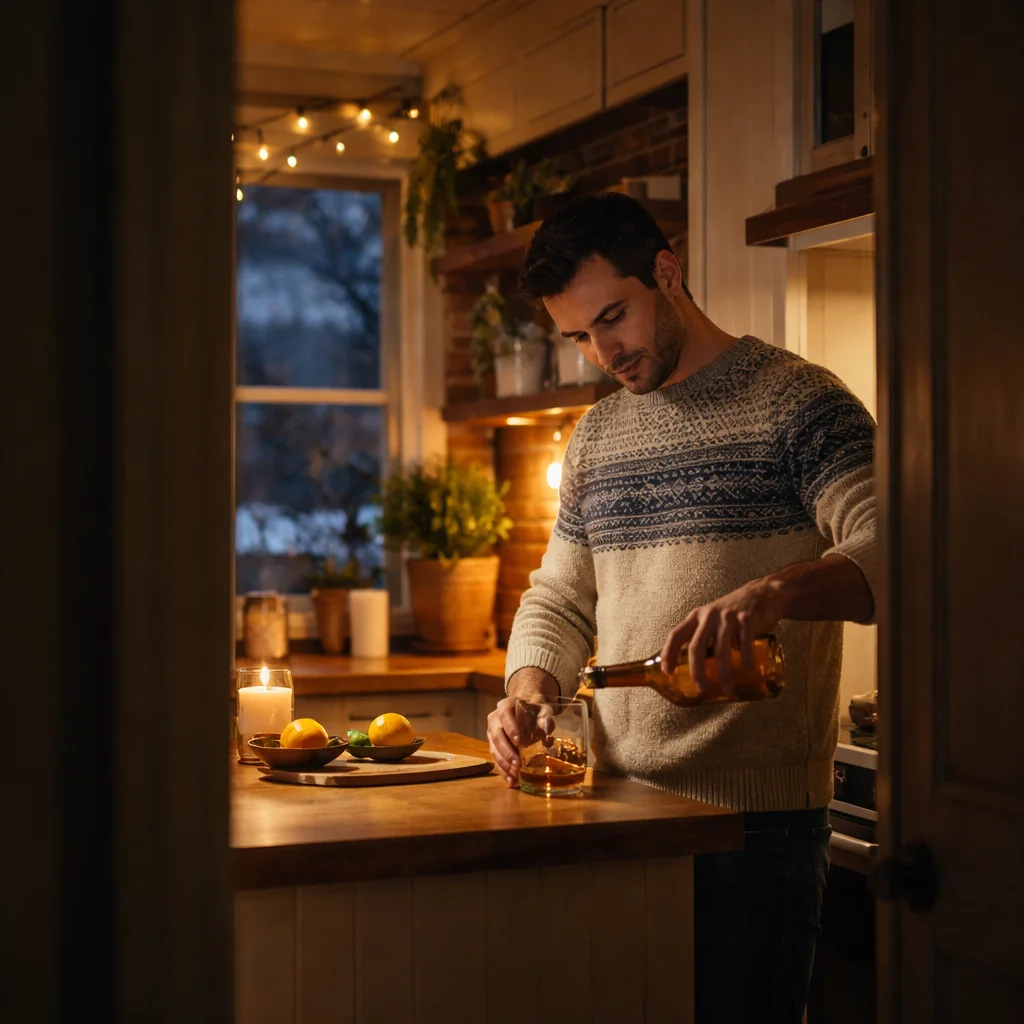
Winter drinking is quiet. It happens on a Tuesday at 5:40pm, in your own kitchen, with the lights already on and nothing on the calendar.
That difference matters more than it sounds. We looked at the warm-weather version of this in our piece on why so many people drink more in summer, and the winter version runs on almost the opposite machinery.
Summer adds occasions. Winter removes alternatives.
Nothing about winter drinking feels like a problem while it is happening. That is exactly why it works so well.
Winter Does Not Announce Itself
The habit shifts that stick are usually the ones you never actively agreed to. Winter is full of them.
You are not deciding to drink more. You are deciding to stay in, and staying in comes with a glass. You are deciding to see people, and in November that means a bar instead of a park.
The volume goes up by one, then one more, spread across enough weeks that no single night ever looks like the turning point.
This has been mapped at a scale most people would not expect. A large international analysis found that colder weather and fewer hours of sunlight are associated with higher alcohol consumption.
That association held both across countries and across individual US states.
The effect is not a discipline problem. It tracks with climate and daylight, which means it acts on nearly everyone to some degree, including people who have never given their drinking a second thought.
What Actually Changes Between October and January
Four things shift at roughly the same time. Individually, each one is almost too small to mention. Together they rewrite the shape of your week.
The Dark Arrives Before Dinner
When it is fully dark at 4:45pm, the evening feels much longer than it actually is. The stretch between finishing work and going to bed reads as one long undifferentiated block.
Alcohol is very good at filling a block of nothing. It is also very good at marking the end of the workday when there is no daylight left to do that job for you.
In July, the sun going down is the signal. In December, you have to supply your own, and a drink is the easiest signal within reach.
Socializing Moves Indoors and Centers on a Drink
Summer socializing has scaffolding. Hikes, patios, ball games, backyards, kids running around, all of it structured around something other than the bar.
Winter socializing loses most of that scaffolding. What is left is dinner out, someone's living room, and the bar down the street, and all three arrive with a drink already built into the plan.
The number of times you see friends may not change at all. What changes is that almost every one of those times now has alcohol at the center of it.
Cozy Becomes a Reason
There is an entire aesthetic built around winter drinking, and it is genuinely appealing. Red wine and a blanket. Whiskey by the fire. The hot toddy you have quietly decided is basically a cold remedy.
None of that is exactly a lie. The problem is that "cozy" is an unusually flexible justification, and it is available every single night from November through March.
Summer reasons expire. The barbecue ends. Cozy does not expire, because the cold does not.
You Move Less and See Less Daylight
Exercise routines get quieter when it is dark and freezing. Outdoor time shrinks down to the walk from the car to the front door.
Both of those changes drag on mood and raise low-grade restlessness. Alcohol is the fastest available correction for either one, and it works immediately, which is the whole trouble with it.
Why the Winter Creep Is So Hard to Catch
Summer excess leaves evidence behind. Sunburns, photos, a group text about how rough Sunday was going to be.
Winter excess leaves almost nothing. Two glasses of wine on a Wednesday does not produce a hangover you would call a hangover, and it does not produce a story anyone retells.
There is also no honest comparison point. Your internal reference for "normal" is last week, and last week was already slightly elevated. Then the week before that becomes the new floor.
That is what makes creep fundamentally different from a binge. A binge is an event you can point at afterward. Creep is a slow redefinition of the middle, and the middle is invisible by design.
It also helps that everyone around you is doing the same thing. When your whole social circle drifts up together, nothing looks like drift.
The Holiday Stack, Halloween Through New Year's
Then the calendar piles on. From late October to January 1, occasions arrive close enough together that you are almost never more than ten days out from one.
Halloween parties come first. Then Friendsgiving, then Thanksgiving itself, plus the night before Thanksgiving, which in a lot of American towns is the single busiest bar night of the year.
Then the office party, the neighborhood thing, the college friends who are back in town, Christmas Eve, Christmas Day, the strange flat week that follows it, and New Year's Eve sitting on top of all of it.
Population-level analyses of daily drinking confirm real, measurable spikes around Christmas and New Year's Eve compared with ordinary weekends. That part surprises nobody.
The part that matters more is the space between the events. Two weeks of "well, it is basically the holidays" wrapped around every actual occasion.
Add it up and the permission structure runs continuously. We go deeper on that whole stretch in our guide to holiday alcohol consumption.
By the time January arrives, the elevated pattern has been running for roughly ten weeks. Ten weeks is more than long enough for an exception to stop feeling like one.
What Changes, How It Shifts Drinking, and What Actually Helps
How Two Extra Drinks a Week Becomes Your February Baseline
Here is the arithmetic almost nobody runs in November.
Two extra drinks a week is nothing. One additional glass on a Wednesday, one more on a Saturday. Across the ten weeks from Halloween to New Year's, that comes out to twenty drinks.
Twenty drinks over ten weeks is not the thing that changes your life. The pattern underneath it is.
Ten weeks of pouring at 5:30 teaches your brain that 5:30 is when you pour. Habits form on repetition rather than on intention, and winter supplies an enormous amount of repetition.
Alcohol also reinforces itself in a way that most habits do not. The endorphin release that follows a drink is what makes the next drink easier to reach for, and repetition strengthens that loop.
So February arrives. The parties are finished, the calendar clears, and the reason for the drink is gone. The drink is not.
That is the creep in one sentence. Not a dramatic increase, just a new floor that nobody set on purpose and nobody notices until spring.
For reference, the National Institute on Alcohol Abuse and Alcoholism defines heavy drinking as eight or more drinks per week for women and fifteen or more for men.
Plenty of people cross that line seasonally without ever feeling like they crossed anything at all.
The Sleep Part Nobody Factors In
There is a second loop running alongside the first one, and it makes winter harder than it needs to be.
Alcohol is a sedative, so it does shorten the time it takes to fall asleep. What it does not do is deliver the deep, restorative back half of the night, which is the part that actually resets your mood.
So you wake up flat. Flat plus a dark morning plus no daylight before noon is a rough combination, and by 5:30 the drink looks useful again.
Breaking that loop anywhere works. Most people find the easiest place to break it is the first drink, not the fifth.
A Light Way to Keep a Baseline Through Winter
None of this requires quitting, and none of it requires something that takes over your life. Winter mostly asks you to make one decision in advance instead of forty small decisions in the moment.
Write Down Your Number Before Halloween
Pick a weekly number that feels honest right now, in September or October, before the season has an opinion about it.
A specific number does something a vague intention cannot. Expert consensus work on behavior change ranks goal setting and self-monitoring among the techniques most likely to reduce alcohol use.
"Drink less this winter" is not a number. "Eight in a week" is a number, and you will know within four days whether it is holding.
Count by the Week, Not by the Night
Single nights make terrible data. A wedding, a work party, and a random Tuesday are not comparable events, and grading yourself night by night mostly generates guilt.
Weeks smooth all of that out. A heavy Saturday sitting inside an otherwise quiet week is still a quiet week, and treating it that way keeps you in the game.
Decide What the Holiday Weeks Look Like in Advance
You already know which weeks in December are going to be heavy. Deciding that in October is very different from discovering it on December 14.
Pick the two or three events that genuinely matter to you and plan the rest around them. The office party you are dreading does not need to cost you the same as Christmas Eve.
Give Winter Something Other Than Drinking to Do
The most useful winter move is having one standing plan that does not involve alcohol. A class, a gym slot, a recurring walk with a friend, a Sunday morning thing you would feel bad about skipping.
It works because it competes for the same slot. Darkness and boredom are the actual openings, and filling one of them closes a door that would otherwise stay open all season.
Watch the Solo Pours More Than the Parties
The office party is not what changes your February. The Thursday glass you pour while making dinner is.
If you track exactly one thing this winter, track how many nights a week you pour alone at home. That number is the honest one.
Our guide to mindful drinking covers a few ways to build that kind of awareness without turning it into a second job.
When Winter Reveals Something Bigger
Sometimes the season is not the cause. Sometimes it just strips away the distractions that were covering something else up.
If you set a number in October and cannot hold it by mid-November, that is worth noticing. Not as a verdict on you, only as information about how much the pull has grown.
The same goes for the drink you have started counting on to make the evening tolerable. When alcohol becomes the thing getting you through a dark stretch, the dark stretch is not really the problem anymore.
Support exists long before anything looks like a crisis. That is the part most people have backwards, and it costs them years.
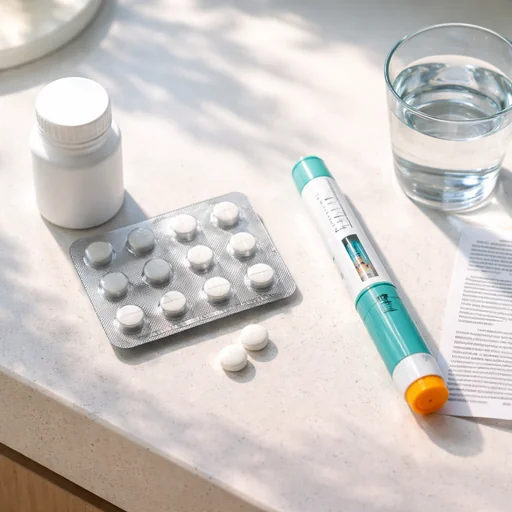
Naltrexone is one option worth knowing about. It is a non-addictive prescription tablet, typically 50mg, that blunts the endorphin release alcohol triggers, so the second and third drink stop pulling the way they used to.
It is not a sedative and it does not make you feel medicated. Most people describe it as the drink simply mattering less.
It works for people aiming to cut back and for people aiming to stop entirely. Both goals are legitimate, and you do not have to choose one at the start.
Our guide on how to start drinking less walks through what those first few weeks actually look like in practice.
Winter Ends. Your Baseline Does Not Have To Move.
The winter drinking creep is not a character flaw and it is not a failure of willpower. It is a season that quietly stacks the deck over about ten weeks, in a way that is genuinely hard to see from inside it.
Which also means it responds well to very small amounts of planning. A number written down in October. One weekly plan that has nothing to do with a bar. A little attention paid to the pours nobody else sees.
Do that much and February arrives with your baseline roughly where you left it in the fall. That is the entire goal, and it is a much smaller ask than most people assume.
If it turns out to be a bigger ask than you expected, that is worth knowing too, and it is worth knowing in October rather than next June.
Frequently Asked Questions
Do people actually drink more in winter?
Patterns vary by country and by how you measure them, but colder temperatures and fewer daylight hours are associated with higher consumption worldwide. In the US, November and December produce the year's densest cluster of drinking occasions.
Why does drinking not go back down in January?
Ten weeks of repetition builds a habit loop that outlasts the reason for it. The occasions end, but the cue (a dark evening, the end of the workday) and the routine (pour a drink) are both still fully in place.
What counts as drinking too much during the holidays?
The NIAAA puts heavy drinking at eight or more drinks per week for women and fifteen or more for men. The season does not move that threshold, though it does make the threshold much easier to cross without noticing.
Should I cut back for the winter or quit entirely?
Neither answer is higher status than the other. Moderation is a legitimate goal with real evidence behind it, and the right choice depends on your history, your health, and what you actually want your winter to look like.
Can I still enjoy the holidays while drinking less?
Yes, and most people report enjoying them more, largely because the mornings are better. Setting your number before the season starts is what makes it feel like a choice you made rather than a restriction imposed on you.
Does naltrexone help with seasonal increases in drinking?
It can. Naltrexone reduces the reinforcing pull of alcohol, which makes it easier to stop after one or two instead of drifting into a fourth, and it supports either goal you decide to pick.
Winter does not have to reset your normal. Take the online Alcohol Use Assessment to find out whether naltrexone from Choose Your Horizon fits the goal you have in mind, whether that is drinking less or not drinking at all.