A 2 minute assessment to get a personalized mental health or alcohol recovery plan.

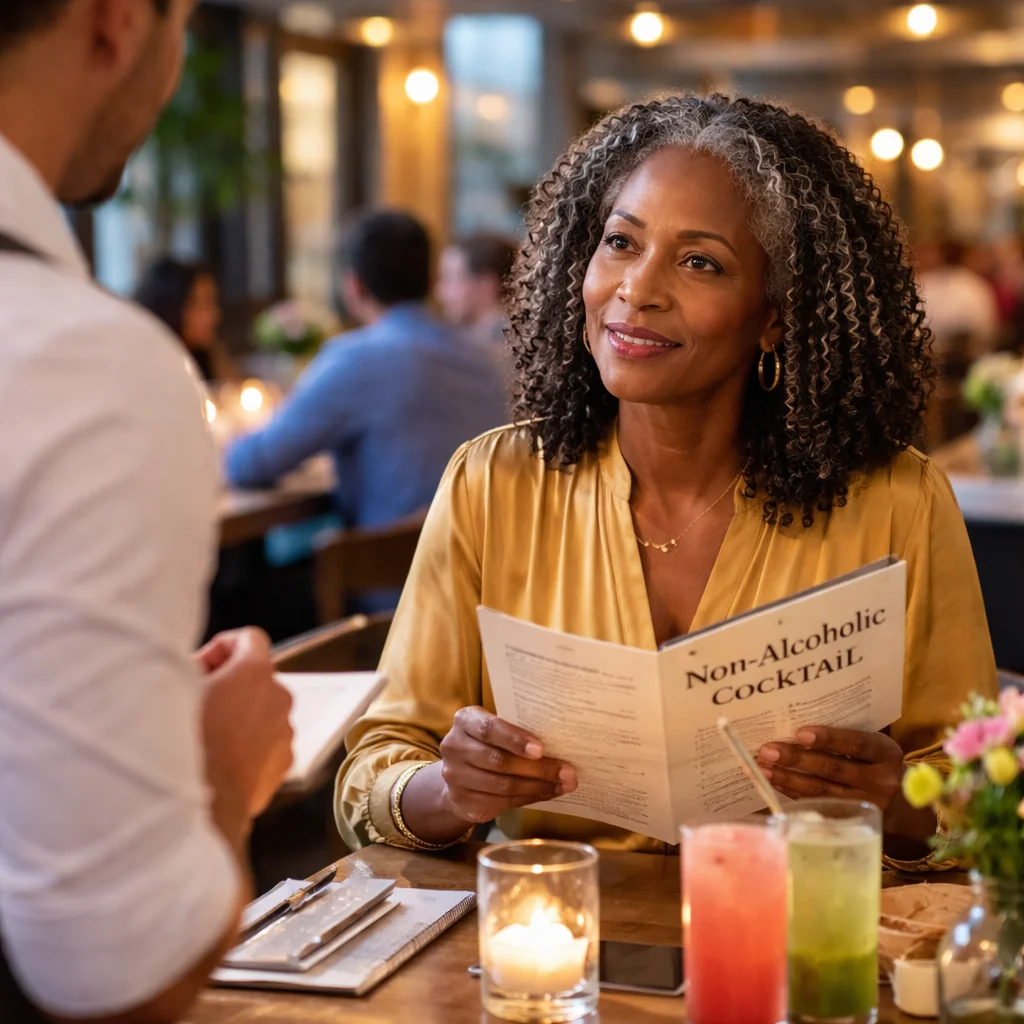
The hard part is not the not-drinking. It is the eight seconds when the server is standing there and everyone else has already ordered. Here is what to ask for and how to say it.
What You'll Discover:
• What restaurants and bars actually stock now, beyond soda water.
• How to order in one sentence without explaining yourself.
• What to do when someone orders wine for the whole table.
• How to handle a server who keeps circling back with the drink menu.
• What to order when the menu genuinely offers you nothing.
The decision is usually made before you arrive. You are not drinking tonight, and you are fine with that.
Then the server appears, three people order cocktails, and it is your turn. That is where the difficulty actually lives, and it lasts about eight seconds.
Those eight seconds get much easier with a plan. Not a speech. An order.
Why the Ordering Moment Feels Bigger Than It Is
There is a real name for what makes that moment hard. Researchers call it drink refusal self-efficacy, meaning a person's belief in their own ability to say no when a drink is offered.
Work on drinking refusal self-efficacy in early intervention trials treats it as a measurable factor that shapes drinking outcomes, not a personality quirk you either have or lack.
The useful part of that framing is that it is a skill. Skills get better with a script and a handful of repetitions, which is a much friendlier problem than a character trait.
There is also good evidence that people abstain situationally all the time. Research on drinking, social abstaining, and refusing invitations describes people who drink at one social event and abstain at the next one, routinely.
So the thing you are worried will look conspicuous is something half the table has done at some point without anyone noticing.
What Restaurants and Bars Actually Stock Now
The options got dramatically better over the last five years. Most decent restaurants also carry more than they print.
Non-Alcoholic Beer
This is the most widely stocked option and the easiest thing to order. Plenty of bars now keep at least one non-alcoholic beer in the cooler even though it never made the menu.
Ask what non-alcoholic beer they have rather than whether they have any. The phrasing assumes an answer, and it usually produces one.
Worth knowing: in the United States, beer labeled non-alcoholic can contain up to 0.5% ABV. If you are aiming at zero, look for products labeled 0.0%, which are now easy to find.
Non-Alcoholic Wine and Sparkling
Harder to find, but improving fast. Non-alcoholic sparkling is the more common of the two and holds up much better in a glass than still NA wine does.
At a nicer restaurant it is worth asking anyway. Places with a serious beverage program often have something they are quietly proud of and almost never get asked to pour.
Zero-Proof Spirits
Distilled non-alcoholic spirits are standard behind good bars now. A bartender who stocks them is usually pleased to be asked, because it is more interesting than pouring another vodka soda.
The most efficient order names a flavor profile rather than a product. Something bitter, something citrus-forward, something in the neighborhood of a gin and tonic.
The Mixer Build
The workhorse order is soda water with something in it. Soda and lime with a splash of cranberry. Ginger beer with lime. Tonic with grapefruit.
Bitters are the classic upgrade, and here is the detail almost nobody mentions. Most bitters are alcohol-based, and a couple of dashes adds a very small amount of alcohol to the glass.
For most people that is negligible. If you have decided on zero, ask for the build without bitters and the bartender will not blink.
Shrubs, Kombucha, and House Sodas
Restaurants with an ambitious kitchen often have something interesting that never makes it to the beverage list. A vinegar shrub, a house-made soda, a spiced lemonade.
Asking the server whether the kitchen makes anything non-alcoholic is a good question at that kind of place. It flips the request from a limitation into a curiosity, which changes how the whole exchange feels.
Kombucha shows up more often now too, usually behind the bar rather than on the menu. It is worth knowing that some kombucha carries trace alcohol from fermentation, typically under 0.5%.
Coffee and Tea Service
At dinner this is badly underrated. Ordering an espresso or a pot of tea while everyone else orders a nightcap reads as a preference rather than an abstention.
Good restaurants take tea service seriously and will bring you something better than you expected. It also puts something in your hands, which matters more than people think.
What to Order and Why It Works
Five orders cover almost every restaurant in the country.
Each of those is one sentence. That is the entire goal here.
How to Order Without Making a Speech
The mistake nearly everyone makes is explaining. Explanation invites a follow-up, and the follow-up is the exact part you were dreading.
Order the way you would order anything else on the menu. Flat tone, no preamble, no apology bolted onto the front of it.
"I'll do a ginger beer with lime" is a complete order. Nothing else is required, and by the time you finish saying it the server has moved on to the next person.
If you want extra insurance, order first. A table follows the first order more than it follows any explanation, and you skip the moment where four cocktails are already on the way.
Our guide on how to say no to a drink has more phrasing for the times when someone does push.
The Work Dinner and the Wine List
Work dinners raise the stakes, because choosing wine is a group activity and declining happens in front of people whose opinion you care about.
The cleanest move is to opt out of the wine conversation without opting out of the ordering conversation. Pass the list along, then order your own drink when your turn comes around.
If someone asks whether you want a say in the bottle, "you pick, I am not drinking tonight" is a complete answer. It is casual, it is final, and almost nobody follows up on it.
The phrase "not tonight" does a surprising amount of quiet work. It makes the choice about this evening rather than about who you are, and tables get much less curious about evenings than about identities.
When Someone Orders for the Table
Every so often, someone orders wine for everybody and a full glass lands in front of you before you can say anything.
Leave it there. An untouched glass draws far less attention than a refused one, and most people at the table will never register it.
If you would rather not have it sitting there, hand it back quietly when the server passes, or order a water at the same time so you have something you are visibly drinking.
The social context genuinely matters, and researchers have mapped it in work on drinking together versus drinking alone. Groups pull toward a shared pattern, which is not a metaphor.
Knowing that helps in the moment. When you feel a pull at a table where everyone is drinking, that is context doing its job, not resolve failing at yours.
The Server Who Keeps Offering
Some servers will come back three separate times with the drink menu. It is their job and it is not about you.
The fix is a short repeat delivered the same way each time. "I'm good with this, thanks."
If it keeps happening, add one detail on the second pass. "Just the ginger beer for me tonight, thanks." Specificity reads as settled, and settled usually ends it.
You do not owe anyone a reason. If you would rather have one loaded anyway, our piece on how to explain not drinking has options that close the topic instead of opening it.
Order the Drink You Actually Want
There is a difference between a placeholder and a drink, and your brain knows which one it is holding.
A glass of tap water is a placeholder. It says the evening is something to get through rather than something to enjoy, and after an hour of that, a real drink starts looking like the only interesting option on the table.
So order something with flavor in it. Something cold, something bitter, something with citrus and ice and a decent glass.
This is not a small point. A lot of people who slip at dinner do not slip because of pressure from anyone else. They slip because they spent ninety minutes drinking nothing while everyone else drank something good.
The fix is embarrassingly simple. Treat the non-alcoholic order as a real order and give it the same thought you would give a cocktail.
When the Menu Has Nothing
Some places genuinely stock nothing. A diner, a small neighborhood spot, a wedding venue with a cash bar and two taps.
The universal fallback is soda water with two limes and a splash of something. Cranberry, pineapple, orange, whatever they already have behind the bar for cocktails.
In a glass it looks like everything else on the table, which removes the last practical obstacle to a normal evening.
For more ambitious builds when you are the one making drinks, our roundup of non-alcoholic cocktails and mocktails covers ones worth repeating at home.
A Quick Note on Labels and Standard Drinks
It helps to know what is actually in the glass. A U.S. standard drink contains about 14 grams of pure alcohol, which works out to roughly 12 ounces of regular beer, 5 ounces of wine, or 1.5 ounces of spirits.
Non-alcoholic beer at 0.5% ABV is a small fraction of that. A whole 12-ounce NA beer lands in the range of a very ripe banana.
For most people that number is irrelevant. For anyone who has decided on zero for medical or personal reasons, 0.0% products exist and are worth asking for by name.
The Bottom Line
The ordering moment is short, and it is a scripting problem far more than a willpower problem.
Decide before you walk in. Order first if the timing works. Use one sentence and skip the explanation entirely.
Then the rest of dinner is just dinner, which is the part you actually came for. Our guide to socializing without alcohol covers the wider version of this.
If the harder part is the wanting rather than the ordering, that is a different problem with a different solution.
Naltrexone is an oral 50mg tablet that blocks the reward signal alcohol sets off in the brain. It is used by people cutting back and by people stopping entirely.
What most people report is that the pull at a restaurant table gets noticeably quieter within two to four weeks. Ordering stops being a decision you have to win and becomes a decision you just make.
Frequently Asked Questions
What is the best thing to order at a bar when you are not drinking?
Non-alcoholic beer if they stock it, since it looks and feels like everyone else's drink. Ginger beer with lime and soda water with a splash of juice are available almost everywhere else.
Do mocktails contain any alcohol?
Usually not, though bitters are alcohol-based and turn up in a lot of mocktail builds. Ask for the drink without bitters if you are avoiding alcohol completely.
Is non-alcoholic beer really alcohol-free?
In the United States, beer labeled non-alcoholic can contain up to 0.5% ABV. Products labeled 0.0% are the ones to look for if you want none at all.
How do I order without explaining why I am not drinking?
Say what you want in one flat sentence, exactly the way you would order food. Explanations invite follow-up questions, and no explanation is owed to anyone.
What do I say at a work dinner when the wine list comes around?
"You pick, I am not drinking tonight" works cleanly. It is casual, it is final, and it keeps the choice about the evening rather than about you.
What if I am the only person at the table not drinking?
That is more common than it looks, and situational abstaining is well documented. Ordering early and confidently is what keeps it from becoming a topic.
If the wanting is the hard part rather than the ordering, support exists for exactly that. Take the online Alcohol Use Assessment to find out whether naltrexone and Choose Your Horizon's integrated solution are a fit for you.