A 2 minute assessment to get a personalized mental health or alcohol recovery plan.

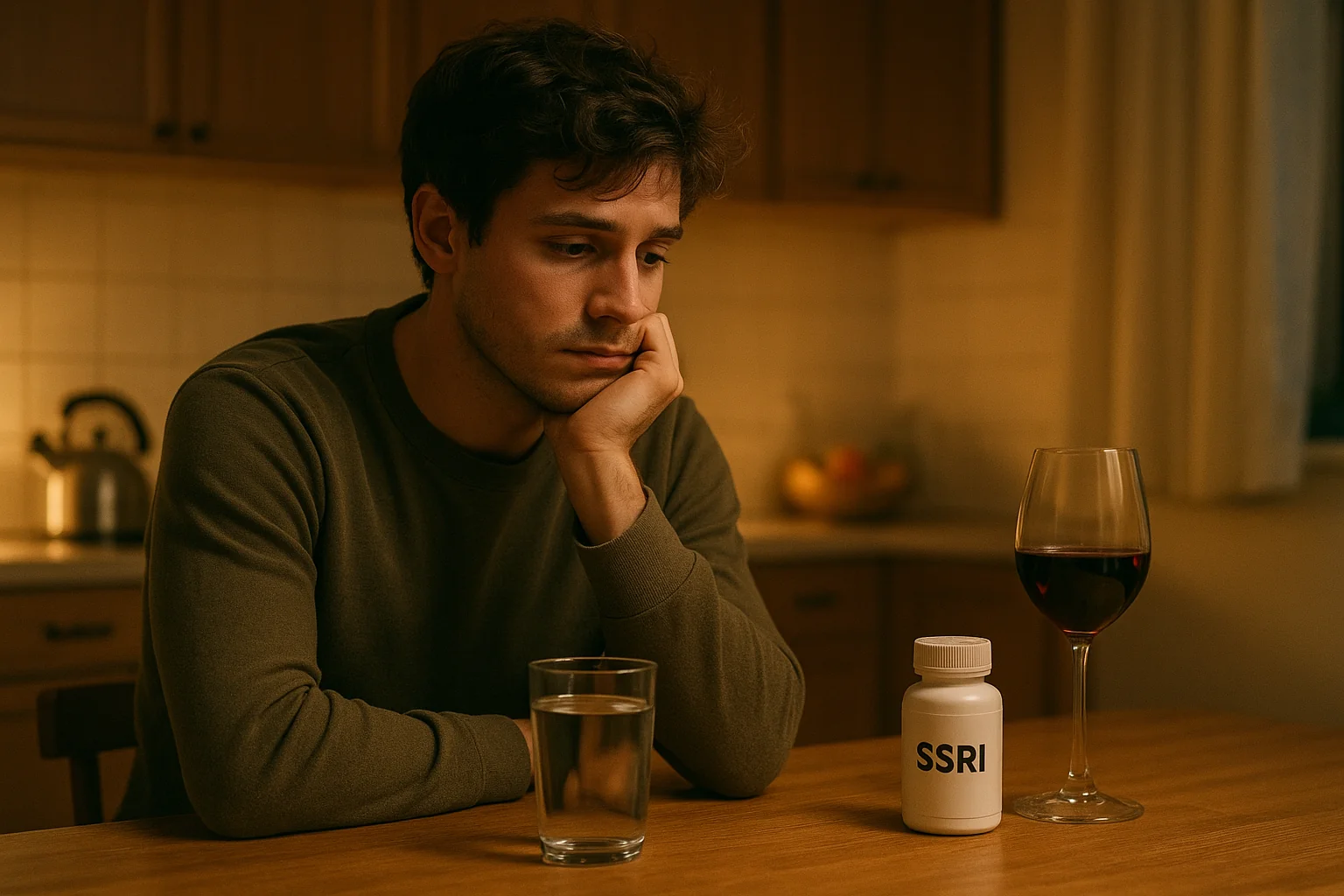
SSRIs rarely cause dangerous acute reactions with alcohol, but the combination consistently amplifies intoxication, worsens next-day anxiety, and reduces the medication's clinical benefit. Here is what the research actually shows.
What You'll Learn:
• What specifically happens when alcohol and SSRIs meet in the body.
• Why most patients feel more drunk from less alcohol when on an SSRI.
• How drinking affects the timeline and quality of SSRI treatment response.
• What the main SSRIs share in their interaction with alcohol, and where they differ.
• How to have a productive conversation with your prescriber about your actual drinking.
Selective serotonin reuptake inhibitors, the class of antidepressants commonly known as SSRIs, are among the most prescribed medications in the United States. They include sertraline, escitalopram, citalopram, fluoxetine, paroxetine, and fluvoxamine. Millions of people take them for depression, anxiety, panic disorder, obsessive-compulsive disorder, and post-traumatic stress disorder.
A substantial share of those millions also drink alcohol, often with some version of "my doctor said try to avoid it but a little should be fine" in the back of their mind. This article lays out what the research actually shows about the interaction, what you are likely to notice in practical terms, and what to do if drinking is getting in the way of your care. It is educational and not medical advice.
What SSRIs Do
SSRIs raise the amount of serotonin available in the spaces between nerve cells in the brain. Over several weeks, this change in serotonin signaling produces downstream adjustments in circuits involved in mood, anxiety, and obsessive thinking. The reason SSRIs take three to six weeks to work is that the neural adaptation takes time. The initial pharmacological change is fast. The therapeutic effect develops slowly.
That slow developmental pattern is important to the alcohol story, because alcohol disrupts the same systems that are trying to adapt. The disruption does not always feel dramatic in the moment, but it compounds across days and weeks.
What Alcohol Does to Serotonin
Alcohol has complex effects on serotonin signaling. Acutely, it modulates serotonin release and receptor function in multiple regions of the brain. Chronically, heavier drinking is associated with lower serotonin transporter availability and altered receptor sensitivity.
For someone on an SSRI, this means that every drinking episode adds an acute perturbation to a system that is trying to stabilize into a new steady state. Over weeks and months, regular drinking keeps nudging the system, which tends to reduce the magnitude of the eventual therapeutic response.
A narrative review in Alcohol summarizing the interaction between antidepressants and alcohol found that alcohol diminishes antidepressant effectiveness across multiple classes, with SSRIs being one of the most commonly affected.
Why You Get Drunker Faster on an SSRI
Many patients report that alcohol hits harder once they start an SSRI. One drink feels like two. Two feel like four. This is a consistent enough observation that it appears in patient-facing summaries from the Cleveland Clinic and Mayo Clinic.
The mechanism is pharmacodynamic rather than pharmacokinetic. Blood alcohol levels are not meaningfully different. What changes is how the brain experiences them. The combination of SSRI-induced serotonin modulation and alcohol's effects on GABA, glutamate, and dopamine produces more sedation, more disinhibition, and more cognitive impairment per drink than alcohol alone would.
The practical implication is straightforward. Do not expect your drinking tolerance to be the same after you start an SSRI. The old "two drinks feels fine" benchmark will probably overshoot. A real amount of impairment arrives sooner.
The Next-Day Anxiety Problem
Many patients take SSRIs for anxiety specifically, and the medication helps. They then drink on weekends and find that their anxiety returns, sometimes with a vengeance, the next morning. This is frustrating and often confusing. The medication did not fail. Alcohol temporarily reversed much of its benefit.
The mechanism involves the rebound phase as alcohol clears. During drinking, alcohol produces a net sedative effect. As it clears overnight, the brain compensates with a surge of excitatory signaling. For someone prone to anxiety, this rebound feels like full-on anxiety with a racing heart, often starting in the early morning hours. The SSRI had been quieting that response. Alcohol unquieted it.
If you are on an SSRI for anxiety and have noticed that your morning anxiety is worse after drinking, you are not imagining it, and the pattern is not a sign that your medication has stopped working. It is a sign that alcohol is actively countering it.
Are Some SSRIs Worse with Alcohol Than Others
The short answer is that all SSRIs share the general pattern described above. Minor differences exist in how sedating individual SSRIs are at the typical dose. Paroxetine tends to be a bit more sedating than most. Fluoxetine tends to be more activating. These differences influence how alcohol feels in combination, but they do not change the fundamental picture. Regular drinking undermines all of them.
Specific warnings from prescribing information tend to emphasize that combining SSRIs with alcohol can increase drowsiness, dizziness, and impaired judgment. They do not generally flag severe acute toxicity the way warnings for some other classes do, which is why prescribers often soften the absolute "no alcohol" line to "minimize."
Suicidal Ideation, A Specific Warning That Deserves Attention
SSRIs carry a black box warning about a small but real increase in suicidal thinking in some patients, particularly in the early weeks of treatment and in younger patients. Alcohol independently lowers impulse control, disinhibits behavior, and worsens mood. The combination can amplify this risk.
This is not theoretical. The period right after starting an SSRI is a period when patients should be in close contact with their prescriber, and heavy drinking during that window is a situation that deserves specific caution. If you are starting an SSRI and find yourself drinking more than usual to cope with the transition, that is a conversation worth having with your clinician before something goes wrong.
The Pattern That Actually Hurts Treatment
Plenty of people take SSRIs and drink occasionally at a wedding, holiday, or dinner party without running into trouble. That is not the pattern that typically undermines care.
The pattern that undermines care is regular drinking that has become a default. Two glasses of wine most evenings. Several drinks on weekends. Alcohol woven into stress management, social engagement, and sleep initiation. This pattern is what most people are doing when they say they "drink a normal amount," and it is also what most quietly limits how much better an SSRI can make them feel.
As we cover in our article on alcohol free lifestyle, shifting the default can produce broad mental health benefits. For patients on SSRIs, those benefits often show up as the medication finally working the way the prescriber hoped it would.
When Cutting Back Is Harder Than Expected
Many patients on SSRIs are drinking precisely because their baseline mental health is hard. Removing alcohol is not just removing a drink. It is removing a coping mechanism that has been doing real, if imperfect, work.
This is where medical support for alcohol cravings becomes relevant. Naltrexone is a prescription medication that blunts the pleasure signal alcohol sends to the brain. Over a few weeks, cravings reduce meaningfully. Importantly for this population, naltrexone does not have significant interactions with SSRIs and can be taken alongside them. Many patients find that combining an SSRI with naltrexone produces better outcomes on both the mental health and drinking fronts than either alone.
Our guide to how to use naltrexone to stop alcohol cravings walks through how the medication fits into a broader plan. And for patients on antidepressants specifically, our post on drinking on antidepressants covers the broader picture.
Having the Conversation With Your Prescriber
A candid conversation with your psychiatrist or primary care clinician is the starting point for most patients. The main things to share:
• Your actual average weekly drinking, not your best week.
• Whether drinking patterns have changed since starting the medication.
• Whether you have noticed amplified intoxication, worse next-day mood, or rebound anxiety.
• Whether you have tried to cut back and how it has gone.
Clinicians are generally not surprised by honest answers to these questions. What frustrates them is having to adjust a medication because the underlying picture was not shared. Give them the data and they can help you build a better plan.
When to Seek Urgent Care
If you experience new or worsening thoughts of self-harm, particularly in the early weeks of starting an SSRI or after drinking, reach out to a mental health professional immediately or call 988 in the United States for free, confidential support.
If you experience tremors, sweating, rapid heartbeat, or confusion when you try to stop drinking, do not try to stop on your own. Alcohol withdrawal can be dangerous and should be managed in a clinical setting.
Bottom Line
SSRIs and alcohol do not usually cause dramatic acute problems when they meet. What they do is cancel out much of what you are taking the medication for. Amplified intoxication, worse next-day anxiety, reduced medication benefit, and a cap on how much better you can feel. For patients on SSRIs whose drinking is more than occasional, addressing alcohol directly is often the step that makes the medication work the way it was supposed to.
If drinking has quietly become part of your SSRI treatment, our online Alcohol Use Assessment can help you see where your pattern sits and whether adding naltrexone alongside your current regimen could help. CYH clinicians regularly work with patients already on SSRIs.
This article is educational and is not medical advice. Decisions about SSRIs, alcohol, or prescription medication should be made with a qualified clinician who knows your full medical history.