A 2 minute assessment to get a personalized mental health or alcohol recovery plan.

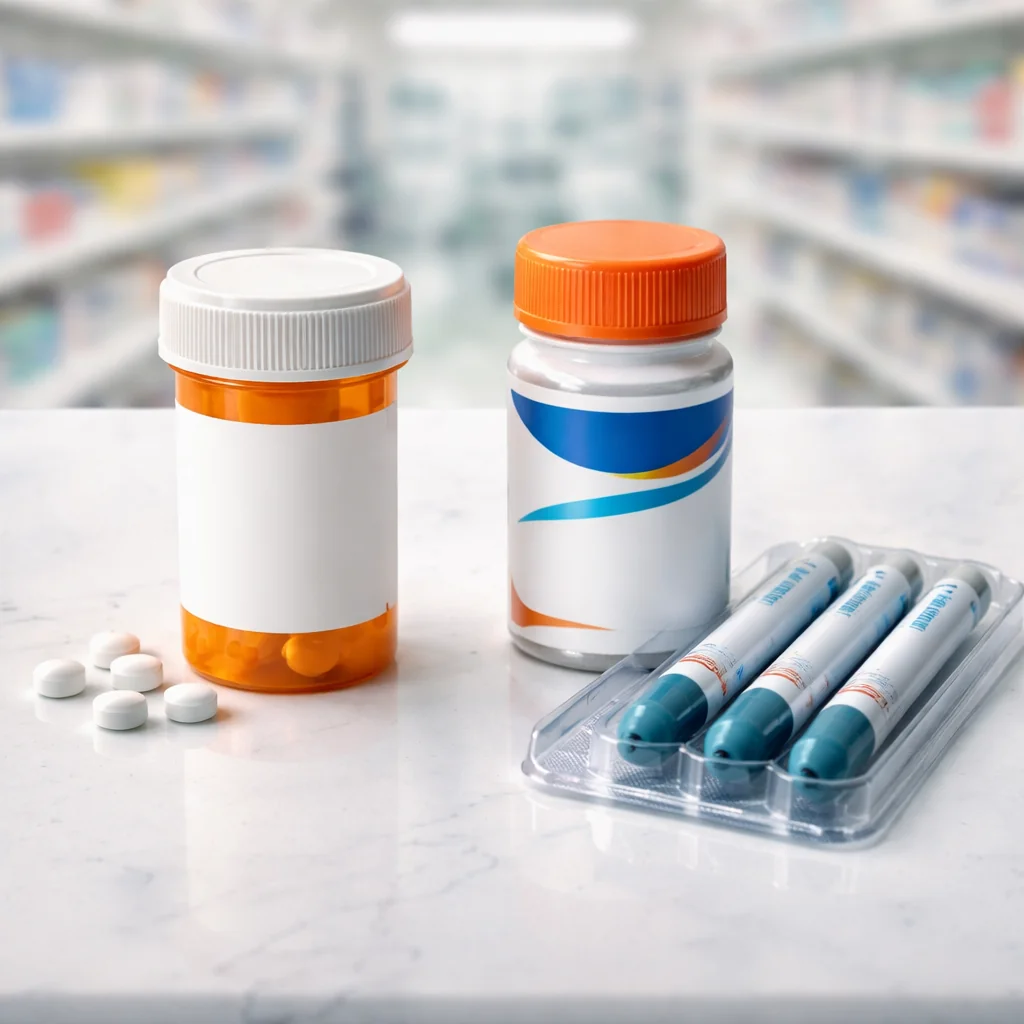
When the goal is drinking, one of these medications is generic and FDA-approved for it. The other is neither, and that single fact drives almost the entire price difference.
What You'll Discover:
• Why the cost gap between these two options is so wide.
• What FDA approval status has to do with your pharmacy bill.
• Why insurance rarely covers a GLP-1 when the reason is drinking.
• What telehealth pricing typically includes.
• How the combination option works under one physician.
GLP-1 medications have gotten a lot of attention for a side effect that surprised almost everyone. People taking them for diabetes or weight started reporting that they wanted alcohol less.
That is a genuinely interesting finding and the research is moving fast. It is also, right now, an expensive way to address drinking.
Naltrexone sits at the other end of the price range. It is generic, it has been FDA-approved for alcohol use disorder since 1994, and it costs a small fraction of what a GLP-1 costs.
This is the honest version of that comparison. Real ranges, the reasons behind them, and what changes depending on your insurance. Prices move constantly, so treat every number here as a general range rather than a quote.
The Short Answer on Cost
Generic oral naltrexone is inexpensive. In a 2025 randomized clinical trial published in JAMA Internal Medicine, researchers priced a 30-day supply of oral naltrexone at $38.10.
That is a research-setting figure, and retail cash prices vary by pharmacy, state, and quantity. But it tells you the order of magnitude, which is tens of dollars a month rather than hundreds.
GLP-1 medications sit in an entirely different range. Cash prices for brand-name versions are commonly quoted in the high hundreds to four figures per month.
Manufacturers also adjust direct-pay programs often enough that any specific number you see is a snapshot rather than a stable price.
Even for people with insurance, the out-of-pocket amount swings enormously. In a study of nearly 62,000 privately insured adults starting a GLP-1 for type 2 diabetes, the highest out-of-pocket quartile ranged from $80 to $3,375 for the first 30 days.
That is the same medication, the same insurance market, and a forty-fold spread. Cost predicted whether people kept taking it, with the highest-cost group showing 25% higher odds of not staying adherent.
So the honest summary is this. Naltrexone for alcohol is a predictable, small monthly cost. A GLP-1 for alcohol is an unpredictable and usually large one.
Why the Price Gap Exists
One Is Generic and One Is Not
This is most of the story. Naltrexone lost patent protection long ago and is manufactured by multiple generic makers, which is exactly the market condition that drives prices down.
GLP-1 medications are still under patent. There is one manufacturer per brand, and pricing reflects that.
Generic competition typically cuts drug prices dramatically over time. Naltrexone has had three decades of it. GLP-1 medications have had none.
Manufacturing Complexity
Naltrexone is a small molecule in a tablet. It is cheap to make, cheap to ship, and cheap to store.
GLP-1 medications are peptides. They require more complex manufacturing, cold-chain handling, and injection devices, all of which sit inside the price.
That gap will narrow eventually. It has not narrowed yet.
Demand Is Enormous
GLP-1 demand from the diabetes and weight markets has been extraordinary, and there is no pricing pressure on a product that sells everything it can produce.
Naltrexone has no comparable demand story. It is a quiet generic that has been available since 1994 and is not competing with anyone for supply.
The Insurance Problem, Specifically for Drinking
FDA Approval Is What Insurers Look At
Here is the part that catches people off guard. Insurance coverage is tied closely to what a medication is approved to treat.
Naltrexone is FDA-approved for alcohol use disorder. StatPearls documents that approval, which dates to 1994, along with its mechanism as an opioid receptor antagonist.
That approval means a prescription written for drinking is a prescription written for an approved indication. Coverage is far more straightforward, and even when it is not covered, the cash price is low enough that it rarely matters.
GLP-1 medications are not FDA-approved for alcohol use disorder. They are approved for type 2 diabetes and, in some formulations, for weight management.
What "Off-Label for Drinking" Means at the Counter
A physician can legally prescribe a medication off-label. That is normal medicine and it happens constantly.
Insurance is a separate question. Plans generally cover a medication for its approved indications, and many require prior authorization with documented diagnosis codes even then.
If the reason on the chart is drinking rather than diabetes or obesity, most plans will decline. Which means the realistic scenario for someone using a GLP-1 primarily for alcohol is paying cash.
Coverage Is Uneven Even for Approved Uses
The access picture is messy even when the indication is approved. A Nature Medicine analysis described substantial inequalities in who actually gets GLP-1 medications, driven by coverage gaps and access barriers rather than clinical need.
That matters for planning. Coverage that exists on paper often does not survive contact with a prior authorization process.
We break down the naltrexone side of that equation in our guide to naltrexone cost for alcohol treatment, including what changes when you use insurance and when you do not.
Naltrexone vs a GLP-1 for Alcohol, Side by Side
This table compares the two options specifically for drinking, not for diabetes or weight, where the answers are different.
What Telehealth Pricing Typically Includes
Cash pricing through telehealth is usually structured differently than a pharmacy counter, and it is worth understanding what you are buying.
Most naltrexone-focused programs charge a one-time consultation fee and then a medication plan billed monthly, quarterly, or annually. Longer plans generally lower the per-month cost.
The medication plan usually bundles more than the pills. Common inclusions are the prescription itself, discreet shipping, ongoing messaging with a care team, and drinking and mood tracking tools.
Some programs add health monitoring, such as at-home liver testing, and some add coaching or group support at a higher tier.
The reason that structure matters for a cost comparison is that a bundled telehealth price is not the same thing as a drug price. It includes the clinician time that a pharmacy price does not.
GLP-1 telehealth pricing works the same way structurally, but the medication component is far larger, so the total lands in a different range entirely.
For a closer look at what naltrexone actually runs when insurance is not in the picture, see our breakdown of naltrexone cost without insurance coverage.
The Evidence Gap Is Also a Cost Question
Cost and evidence are related in a way that is easy to miss.
Naltrexone for alcohol has been studied in a very large body of randomized controlled trials, pooled in meta-analyses covering tens of thousands of participants. That is why it holds an FDA approval and why prescribers reach for it first.
GLP-1 medications and alcohol are at an earlier stage. The signal in the data is real and researchers are taking it seriously, but the trials are smaller and the picture is still forming.
Paying a premium price for an early-stage indication is a different value proposition than paying a low price for a well-established one. That is not an argument against GLP-1 research. It is just an honest framing of where the two options sit today.
We compare the two on effectiveness rather than price in our piece on naltrexone vs GLP-1 for alcohol use disorder.
The Combination Option Under One Physician
A lot of people asking this question are not choosing between the two. They are already on a GLP-1 for weight or diabetes and are wondering whether they still need something for drinking.
That is a reasonable place to be, and the two are not mutually exclusive. They work through different mechanisms, which is part of why a physician may keep both in play.
Naltrexone blocks opioid receptors, which interrupts the endorphin and dopamine response that makes one drink lead to the next. GLP-1 medications act on appetite and reward pathways more broadly.
The cost logic here is straightforward. If the GLP-1 is already covered or already being paid for because of diabetes or weight, adding an inexpensive generic for the drinking is a small incremental cost.
What matters is that both are managed by the same physician who can see your full medication list, health history, and liver function. Splitting prescribers across two services is how interactions get missed.
Our guide on taking a GLP-1 and naltrexone together covers the clinical side of that in more detail.
How to Think About the Real Number
The sticker price is only part of the calculation. Two other things belong in it.
The first is adherence. A medication you stop taking because of cost has an effective value of zero, and the GLP-1 out-of-pocket research showed exactly that pattern.
The second is what your drinking currently costs. For a lot of people, a month of naltrexone costs less than a single weekend of the drinking it is meant to reduce.
That is not a sales line. It is arithmetic that people are often surprised by when they actually run it.
The practical advice is to price out three scenarios before deciding. What your insurance covers, what cash costs at a pharmacy, and what a bundled telehealth plan includes.
Those three numbers are usually much further apart than people expect, and the cheapest option is not always the one with the lowest headline price.
Three Questions Worth Asking Before You Pay
Most people compare headline prices and stop there. These three questions surface the numbers that actually determine what you spend over a year.
What is the total for twelve months, not one. Consultation fees, shipping, lab work, and plan minimums all land in the annual figure and rarely show up in the advertised monthly price.
What happens if it does not work for me. Some plans are prepaid quarterly or annually. Knowing the cancellation and refund terms before you start is worth more than a small discount.
What is included besides the pills. Clinician access, messaging support, and monitoring have real value, and a bare pharmacy price does not include any of them.
There is one more thing to weigh, and it is easy to overlook. Cost is not just what you pay, it is whether you keep taking the medication.
The GLP-1 out-of-pocket research makes that concrete. People in the highest-cost group were meaningfully more likely to stop, and stopping produced worse outcomes downstream.
A low, predictable monthly cost is not only cheaper. It is also more likely to still be in your life six months from now, which is when most of the benefit shows up.
What This Comes Down To
If the goal is specifically drinking less or quitting, the cost comparison is not close.
Naltrexone is generic, FDA-approved for alcohol use disorder since 1994, backed by decades of trial evidence, and priced in the tens of dollars a month.
GLP-1 medications are on patent, not approved for alcohol, rarely covered when drinking is the reason, and priced accordingly.
None of that makes GLP-1 research uninteresting. It makes it early, and early is expensive.
If you are already on a GLP-1 for another reason, the question changes shape entirely and becomes a conversation about combining rather than choosing.
Either way, the version of this that works is the one where a physician who knows your history makes the call, rather than a price comparison made alone.
Choose Your Horizon works with people who want to drink less and people who want to stop entirely, combining naltrexone with coaching and physician-guided care grounded in clinical, neurological, and behavioral science.
Frequently Asked Questions
Is naltrexone cheaper than a GLP-1 for alcohol?
Substantially. Generic oral naltrexone is typically priced in the tens of dollars per month, while GLP-1 medications commonly run in the hundreds to over a thousand. Actual prices vary by pharmacy, plan, and program.
Will insurance cover a GLP-1 if I want it for drinking?
Usually not. GLP-1 medications are not FDA-approved for alcohol use disorder, so a prescription written for drinking is off-label and most plans decline it. Coverage is more likely when the indication is diabetes or weight.
Is naltrexone covered by insurance for alcohol?
Often yes, because it holds an FDA approval for alcohol use disorder. Coverage still depends on your specific plan, and the cash price is low enough that many people pay out of pocket regardless.
Why is naltrexone so much less expensive?
It went generic decades ago and is made by multiple manufacturers, it is a simple tablet rather than an injectable peptide, and there is no supply pressure on it. GLP-1 medications are still on patent with a single maker per brand.
Can I take both a GLP-1 and naltrexone?
Some people do, under one physician who is managing both. They work through different mechanisms, and if the GLP-1 is already being paid for, adding naltrexone is a small incremental cost.
Do telehealth programs include the medication in the price?
Most naltrexone programs bundle the prescription, shipping, and ongoing support into a single plan price on top of a one-time consultation fee. What is included varies by program, so it is worth comparing what you actually get.
Find out what naltrexone would cost for you specifically. Take the online Alcohol Use Assessment to see whether it is a good fit and what a plan would look like.