A 2 minute assessment to get a personalized mental health or alcohol recovery plan.


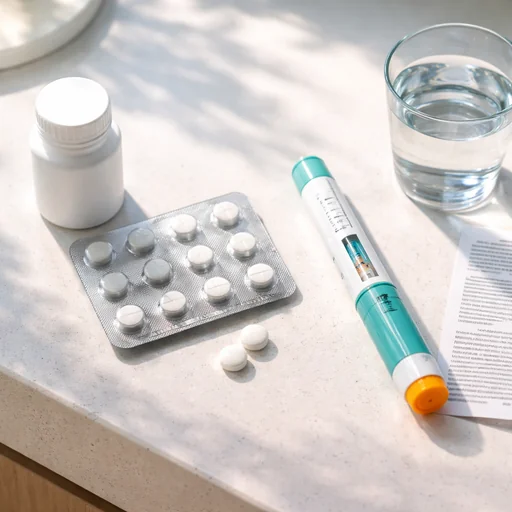
Naltrexone and GLP-1 medications both take the edge off drinking, but they get there by tripping different wires in the brain's reward circuitry. Here's what neuroscience actually shows about how the medications are impacting different pathways, and why hitting both at once could be beneficial.
What You’ll Learn:
• The "wanting vs. liking" framework researchers use to explain how a reward circuit gets hijacked.
• Exactly which receptors and brain regions naltrexone blocks and what that shuts off.
• How GLP-1 medications go beyond the gut to alter the brain.
• What brain-imaging and clinical trials have found when each medication acts on real cravings.
• Why addressing two non-overlapping circuits may be more impactful than either one alone.
Naltrexone and GLP-1 medications keep getting mentioned in the same conversation because they produce a similar outcome: people drink less while taking them. This piece goes under the hood, into the actual circuitry each drug is interrupting.
For the practical comparison of approval history, success rates and side effects see our full naltrexone vs. GLP-1 breakdown.
60-Second Explanation of the Reward Circuits
Almost every drug of abuse, including alcohol, ultimately acts on the same piece of real estate: the mesolimbic dopamine pathway, running from the ventral tegmental area (VTA) in the midbrain to the nucleus accumbens (NAc) in the forebrain. Dopamine released along this pathway is the brain's way of saying "that mattered, do it again."
Neuroscientists split that signal into two component:
• "Wanting" - the dopamine-driven pull toward a cue (a bar, a bottle, a stressful day) before you've had a drink
• "Liking" - the in-the-moment hedonic payoff once alcohol hits the brain, driven largely by the brain's own opioid system
Naltrexone and GLP-1 medications each lean on one side of that split more than the other.
How Alcohol Hijacks the Reward Circuit
When alcohol reaches the brain, it triggers the release of endogenous opioids, chiefly beta-endorphin. Those opioids act on mu-opioid receptors sitting on GABA interneurons inside the VTA.
Normally those GABA neurons keep dopamine neurons in check. But beta-endorphin switches them off, which releases the brake and lets dopamine surge into the NAc. That surge is the molecular basis of the "liking" hit. It’s the reason a drink feels rewarding in real time, not just satisfying a habit.
Naltrexone: Blocking the Hit Each Drink
Prescription naltrexone is a mu-opioid receptor antagonist. It physically occupies the same receptors beta-endorphin would otherwise activate. With those receptors blocked, alcohol can still trigger opioid release, but the release has nowhere to act. The GABA brake in the VTA stays engaged, and the dopamine surge that would normally follow a drink is blunted.
Microdialysis studies in animals back this up directly. Naltrexone doesn't stop alcohol from producing dopamine release entirely, but it does prevent that release from being as prolonged as it would be otherwise. Human imaging work tells a similar story. Naltrexone has been shown to alter activity in the striatum and pallidum, the same reward-adjacent circuitry, even at rest.
Naltrexone's action is tightly tied to the act of drinking itself. It doesn't touch appetite, satiety or the drive that gets someone reaching for a drink in the first place. It mutes what happens biochemically once alcohol is already in the system. That's the "liking" side of the ledger.
GLP-1: Turning Down the Urge Between Drinks
GLP-1 medications start from a completely different anatomical entry point. Endogenous GLP-1 is produced by gut cells and by neurons in the nucleus tractus solitarius (NTS), a brainstem relay station that normally handles satiety signals. But those NTS neurons don't stop at the hypothalamus. They send direct projections into the VTA and NAc, and GLP-1 receptors show up on GABAergic neurons inside the VTA that regulate dopamine output, as well as directly inside the NAc shell, the lateral septum and the laterodorsal tegmental nucleus.
Functionally, activating those receptors does the opposite of what alcohol's opioid surge does. It reinforces the GABA brake on VTA dopamine neurons rather than releasing it, and it does so specifically in the NAc shell, not the core. Researchers increasingly describe this NTS-to-VTA GLP-1 circuit as a built-in "anti-craving" pathway that the drugs are simply amplifying pharmacologically.
Because this circuit runs on a slower, more tonic signal closer to a baseline "how much do I want this" setting than a moment-to-moment "how good did that feel" GLP-1's effects show up less as blunting a single drink and more as dampening cue reactivity and craving between drinking occasions. That's the "wanting" side of things.
What Happens When Reward Circuits Meet Alcohol Cravings
The human data on GLP-1 and alcohol is relatively new and somewhat mixed, but there are some interesting findings that we’re paying attention to:
• A phase 2 trial of once-weekly semaglutide published in JAMA Psychiatry found low-dose semaglutide reduced how much alcohol people actually drank in a supervised lab self-administration task, with medium-to-large effect sizes.
• The larger SEMALCO trial, published in The Lancet, found semaglutide cut heavy drinking days by roughly 41 percentage points from baseline versus about 26 for placebo in people with AUD and comorbid obesity.
• Earlier, a 26-week trial of exenatide found something more interesting. It didn't significantly beat placebo on the primary outcome (heavy drinking days) across the whole group. But brain imaging told a different story. Exenatide significantly reduced fMRI cue-reactivity in the ventral striatum and septal area. In other words, the circuit changed even in people whose drinking hadn't been affected yet.
As for combining naltrexone and GLP-1 specifically for alcohol use disorder, the mechanistic case is there (two non-overlapping upstream levers converging on the same downstream dopamine output), but dedicated clinical trials are only just getting underway so there’s guaranteed to be a lot more information in the coming months and years.
The strongest existing evidence for "hitting two pathways beats hitting one" currently comes from the weight-loss literature, where naltrexone plus GLP-1 therapy has shown additional weight loss beyond either alone. It’s a related but not identical claim to reduced alcohol reward.
Quick Conclusion
Naltrexone and GLP-1 medications aren't redundant tools pointed at the same reward circuit switch. Naltrexone sits downstream, inside the VTA, blocking the specific opioid-driven dopamine surge that makes a drink feel rewarding in the moment. GLP-1 sits further upstream, reinforcing the same circuit's baseline brake from a completely different set of inputs: the gut, the brainstem and the lateral septum.
Combining the two medications means that you’re curbing alcohol cravings from different fronts, making it easier to focus on other aspects of your drinking behaviors so that significant progress can be made. You can learn more about those behaviors and whether naltrexone or GLP-1s are recommended by taking the Alcohol Use Assessment. It is quick, confidential and provides valuable Audit-C information for free.