A 2 minute assessment to get a personalized mental health or alcohol recovery plan.

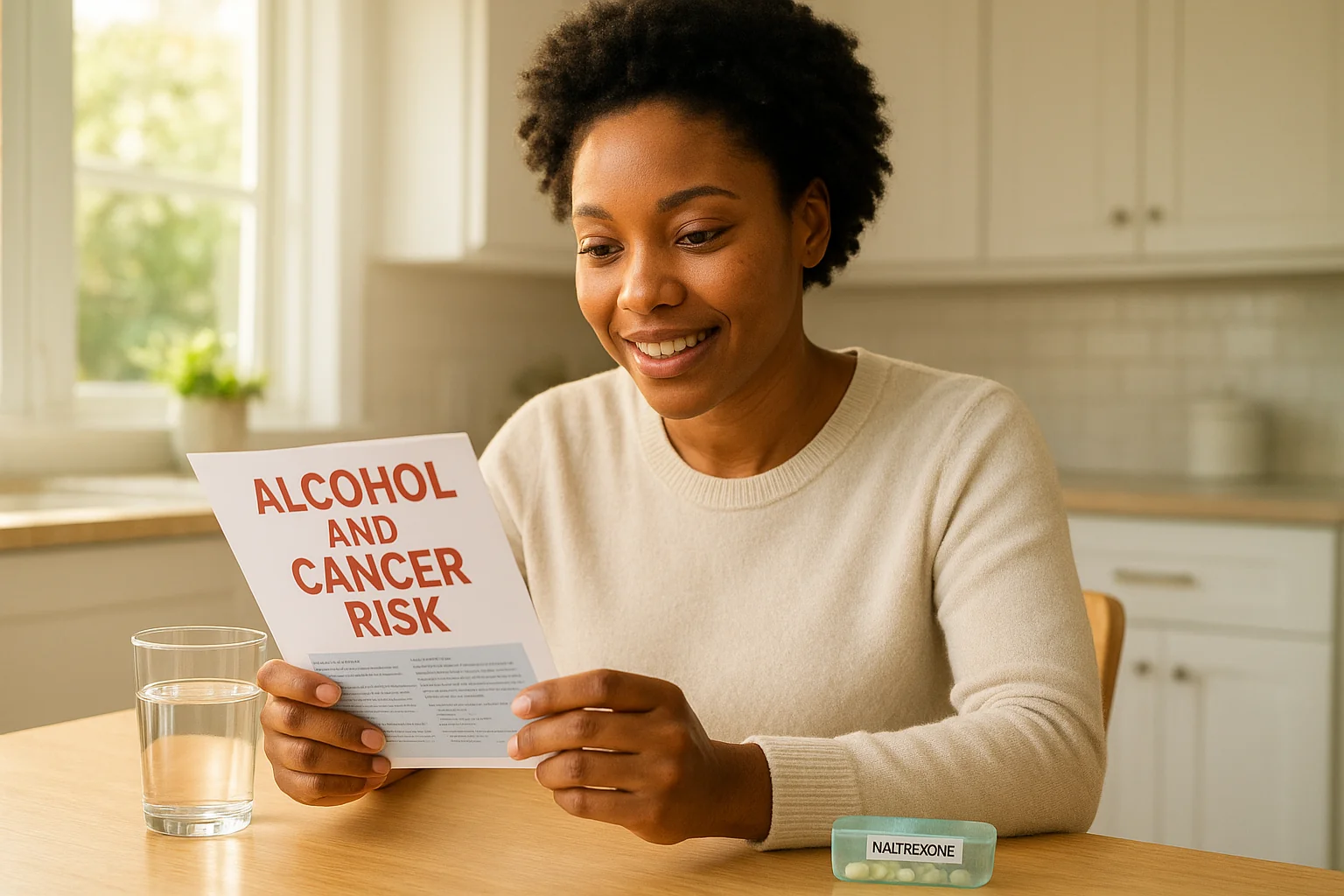
The link between alcohol and cancer is clearer than most people realize, and reducing how much you drink can measurably lower your risk over time.
What You'll Discover:
• Why alcohol is officially classified as a Group 1 carcinogen
• The seven cancer types directly linked to alcohol consumption
• How acetaldehyde damages DNA and drives cancer growth
• Why there is no completely "safe" level of alcohol for cancer risk
• How cutting back on drinking lowers your risk, and how naltrexone can help you get there
Most people know that smoking causes cancer. Fewer know that alcohol does too. Not in a vague, "everything causes cancer" kind of way. In a precise, well-documented, causal kind of way.
The International Agency for Research on Cancer classifies alcohol as a Group 1 carcinogen. That is the highest tier. It sits alongside tobacco, asbestos, and radiation.
This article explains what that classification means, which cancers are involved, and how alcohol causes them at the cellular level. The framing is not meant to scare you. It is meant to give you accurate information so you can make decisions that serve your health.
What "Group 1 Carcinogen" Actually Means
The IARC uses a tiered system to classify substances based on the strength of evidence that they cause cancer in humans. Group 1 means there is sufficient evidence from human studies that the substance causes cancer.
It is not theoretical. It is not based on animal studies alone. The data in humans is clear enough to make the causal conclusion, and alcohol reached that classification decades ago.
According to the National Institute on Alcohol Abuse and Alcoholism, multiple cancer types are now linked to alcohol consumption with strong, consistent scientific evidence.
The classification applies to ethanol itself, the type of alcohol found in beer, wine, and spirits. It is not about additives or mixers. The alcohol is the carcinogen.
The Seven Cancer Types Linked to Alcohol
Alcohol increases the risk of at least seven distinct cancer types. The evidence is not equal across all of them, but all seven have strong scientific support.
Head, Neck, Throat, and Esophagus
Cancers of the mouth, pharynx (throat), larynx (voice box), and esophagus are among the most strongly linked to alcohol. The tissues in these areas are directly exposed to alcohol every time you drink.
The risk scales with amount consumed. People who drink heavily and also smoke face dramatically higher risk than those who do either alone. The two substances appear to work together to cause damage.
Liver Cancer
The liver is responsible for metabolizing alcohol. Repeated heavy drinking over years leads to fatty liver disease, then alcoholic hepatitis, then cirrhosis. Liver cancer most often develops against a background of cirrhosis.
You can read more about how alcohol stresses the liver in our guide to alcohol liver problem symptoms. Globally, alcohol is one of the leading preventable causes of liver cancer.
Colorectal Cancer
Colon and rectal cancers are both linked to alcohol. Even moderate drinking raises risk compared to abstaining.
The colorectal link is worth taking seriously. Colorectal cancer is the second most common cause of cancer death in the United States.
The good news: research shows that liver and colorectal cancer risk begin to drop within a few years of significantly reducing or stopping alcohol consumption.
Breast Cancer
Breast cancer has one of the clearest dose-response relationships with alcohol. Even low to moderate drinking raises risk.
According to the Centers for Disease Control and Prevention, any amount of alcohol increases breast cancer risk.
Part of this connection runs through estrogen. Alcohol increases circulating estrogen levels, and estrogen feeds the growth of many breast tumors.
We explore this hormone connection in detail in our piece on alcohol's effect on estrogen in women and men.
This is why breast cancer is one of the most important reasons for women to be aware of their alcohol intake, even at levels that might seem social or moderate.
How Alcohol Damages DNA: The Acetaldehyde Mechanism
When your body metabolizes alcohol, the first byproduct produced is acetaldehyde. Acetaldehyde is itself a Group 1 carcinogen. It is highly reactive and toxic to cells.
Acetaldehyde binds to DNA and proteins inside cells. When it binds to DNA, it creates abnormal structures that interfere with normal DNA replication.
If the cell cannot repair this damage before it divides, the error gets copied. Errors that accumulate over time can transform a normal cell into a cancerous one.
Acetaldehyde is produced wherever alcohol is metabolized. That includes the liver, of course, but it also includes cells lining the mouth, throat, and esophagus. This is one reason oral and esophageal cancers are so consistently linked to alcohol.
There are other mechanisms too. Alcohol generates reactive oxygen species (free radicals) that damage cell membranes and DNA.
It also impairs the body's ability to absorb protective nutrients like folate, and it raises estrogen levels, which fuels hormone-sensitive cancers.
All of that is to say: alcohol is not a passive bystander. It actively causes molecular damage in tissues throughout the body.
The Dose-Response Relationship: No Truly Safe Threshold
One of the most important findings in alcohol-cancer research is this: the relationship between alcohol and cancer risk is linear. More alcohol means more risk. Less alcohol means less risk.
For several cancer types, that relationship extends all the way down to zero drinks. There is no threshold below which alcohol is definitively proven to cause zero additional cancer risk.
This does not mean a single glass of wine causes cancer. Risk is probabilistic, not deterministic. But it does mean that the concept of a "safe" level of drinking for cancer prevention is not supported by the current evidence.
The National Institute on Alcohol Abuse and Alcoholism acknowledges that even moderate drinkers face elevated risk for certain cancers.
For people who already drink, that information clarifies the landscape. Drinking less is better for cancer risk than drinking more. That is a clear, actionable conclusion.
The 2023 Surgeon General Advisory: A Turning Point
In January 2023, the U.S. Surgeon General issued a formal advisory on alcohol and cancer risk. It was a significant moment in public health communication.
The advisory called for alcohol bottles to carry cancer warning labels, similar to those on cigarette packs. The current federal warning labels do not mention cancer at all. They were last updated in 1988 and focus on pregnancy and driving.
The advisory cited approximately 100,000 alcohol-attributable cancer cases and around 20,000 alcohol-attributable cancer deaths in the United States each year.
The Surgeon General noted that alcohol is the third leading preventable cause of cancer in the United States, after tobacco and obesity.
Most people do not know this. The advisory was direct: the science is clear enough that Americans deserve to be told about this risk at the point of purchase.
Whether the labeling change happens legislatively is a separate question, but the advisory marks a meaningful shift in how authoritative health bodies communicate about alcohol.
Reducing Your Drinking Reduces Your Risk
Here is the part of this story that actually matters for what you do next. The cancer risk from alcohol is not permanent and locked in.
Research shows that reducing or stopping alcohol consumption leads to measurable reductions in cancer risk over time.
The body can repair some of the DNA damage alcohol causes. Cells that were under continuous stress from alcohol exposure begin to recover.
For liver cancer, the risk associated with heavy drinking begins to decrease within years of reducing intake, particularly if cirrhosis has not already developed.
For colorectal cancer, studies suggest that risk declines meaningfully within a few years of cutting back significantly.
For head and neck cancers, former heavy drinkers who have quit show lower rates compared to those who continue drinking.
Breast cancer risk is more complex, but reducing alcohol is consistently associated with lower risk compared to continuing at current levels.
The message is clear: it is not too late. Drinking less now is beneficial regardless of your drinking history.
For a broader look at how your body responds over time, our article on the long-term effects of alcohol covers the full picture.
Naltrexone: A Medical Tool for Drinking Less
Knowing the risks is the first step. Actually changing your drinking is the second, and that is where many people get stuck.
Willpower alone is hard. The biology of alcohol dependence works against you. Naltrexone is an FDA-approved medication that makes it significantly easier to drink less. It works by blocking the reward signal that alcohol triggers in the brain.
When you take naltrexone and then drink, the pleasant buzz is blunted. Over time, the pull toward alcohol weakens.
Across clinical trials involving more than 20,000 participants, naltrexone has been shown to reduce heavy drinking days, reduce total alcohol consumed per month, and increase the number of days people stay abstinent.
Naltrexone is not a cure and it is not right for everyone. But for people who want to drink less and are finding it difficult to do so on their own, it is one of the most evidence-supported tools available.
It is also worth knowing that naltrexone does not require you to commit to complete abstinence. Many people use it as a harm reduction tool, gradually cutting back over weeks or months.
That kind of gradual reduction is exactly what the cancer risk literature says translates into lower long-term risk.
If you are wondering where to start, our guide on how to start drinking less covers practical approaches alongside the medical options available to you.
Putting It Together: What You Can Do
The science on alcohol and cancer is clear, but it is not fatalistic. Here is a brief summary of where things stand:
• Alcohol is a Group 1 carcinogen, the same category as tobacco
• It is causally linked to cancers of the mouth, throat, esophagus, liver, colon, rectum, and breast
• The mechanism involves acetaldehyde (a toxic byproduct that damages DNA), oxidative stress, and hormonal changes
• The dose-response relationship is roughly linear, with no fully "safe" threshold for some cancer types
• Reducing alcohol intake measurably reduces risk over time
None of this means a glass of wine at dinner will cause cancer tomorrow. Risk is cumulative and probabilistic. But if you have been looking for a clear, science-based reason to examine your drinking, this is it.
The good news is that change is possible, and the benefits are real. Your body is not a passive recorder of damage. It is constantly working to repair itself.
Giving it less to repair is one of the most meaningful things you can do for your long-term health.
Take the Next Step
If this article has you thinking about your own drinking, you are not alone. Many people reach a moment where the information clicks and they decide they want support.
Choose Your Horizon offers an online Alcohol Use Assessment to help you understand whether naltrexone could be a fit for your situation.
The process is fully online, discreet, and judgment-free. There is no requirement to label yourself or commit to any particular outcome.
Take the online Alcohol Use Assessment and see if naltrexone could be a good fit for you.