A 2 minute assessment to get a personalized mental health or alcohol recovery plan.

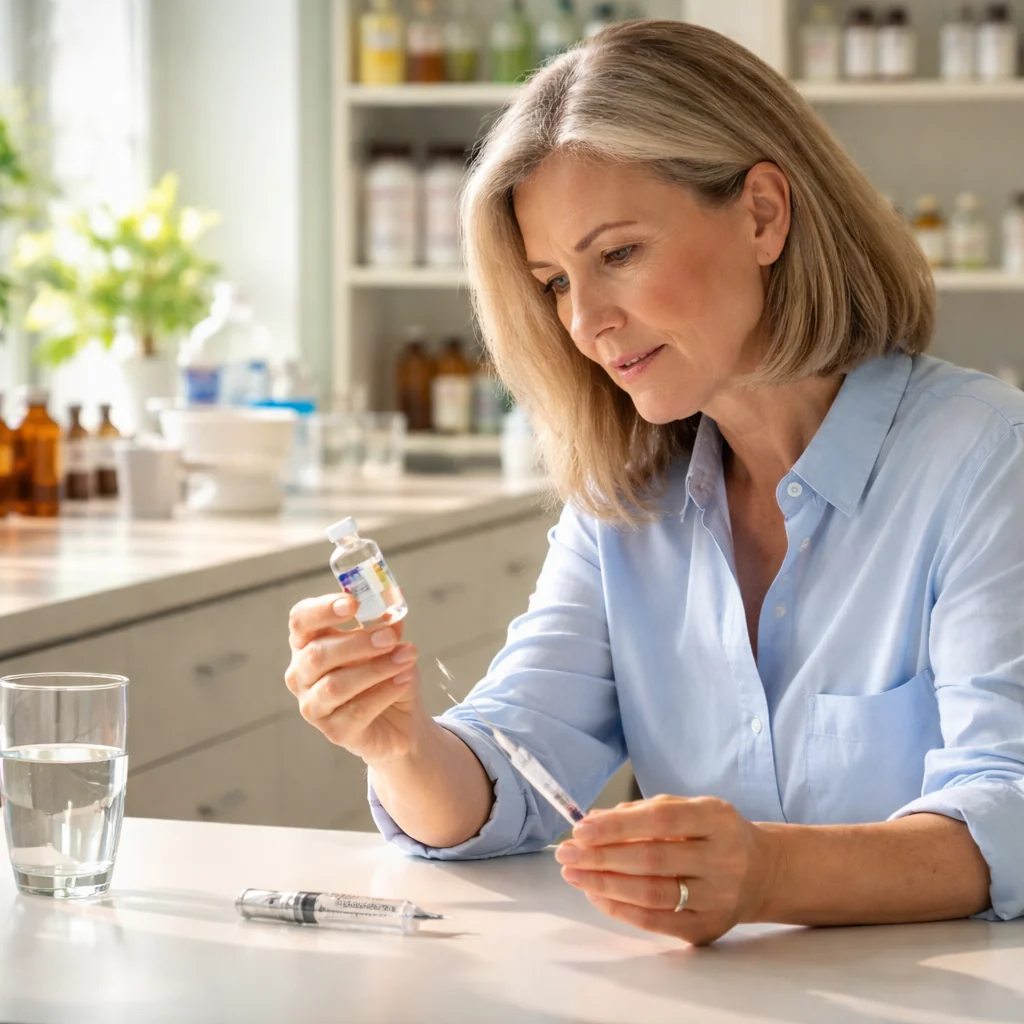
Compounded semaglutide is not automatically unsafe, but the dose in the vial is less certain than a brand-name pen, and that uncertainty is worth understanding if you drink.
What You'll Discover:
• What compounding actually is and when it is legally permitted.
• Why potency and dosing can vary from one compounding pharmacy to another.
• What alcohol really does when a GLP-1 is slowing your stomach down.
• The red flags that mean you should be asking more questions.
• Why having a real prescriber matters more once alcohol is in the picture.
You started a compounded GLP-1 because it was available and it was affordable. Then you had two glasses of wine at dinner and felt considerably more than two glasses of wine.
That experience is extremely common. It also, in most cases, has nothing to do with the compounded formulation itself.
It has to do with how much less you are eating, how far your tolerance has quietly dropped, and how much body water you have lost along with the weight. All three change how a drink lands, and none of them announce themselves.
Compounded medications do carry a specific kind of uncertainty that a brand-name pen does not. That is worth understanding clearly.
It is not a reason to panic, and it is not a reason to stop a medication that is working. It is a reason to ask sharper questions about what you are actually injecting.
What Compounded Semaglutide Actually Is
Compounding is when a licensed pharmacy or physician combines or alters ingredients to make a medication for a specific patient. It has been part of American pharmacy for well over a century.
A child who cannot swallow a tablet gets a liquid version. Someone allergic to a dye gets a formulation made without it. That is compounding doing exactly what it exists to do.
Compounded semaglutide differs from the brand-name product in one way that matters more than any other. As the FDA states directly, compounded drugs are not FDA-approved and do not go through premarket review for safety, quality, or effectiveness.
That is not the same as calling them dangerous. Millions of compounded prescriptions are filled every year without incident.
What it means is narrower and more specific. Nobody outside the compounding pharmacy has independently confirmed what is in your vial, at what strength, or how consistently one batch matches the last one.
When Compounding Is Legally Permitted
A lot of the content online about this is genuinely out of date, because the rules moved twice in about eighteen months.
Federal law generally bars compounders from producing something that is essentially a copy of a commercially available FDA-approved drug. There is an exception when the approved drug sits on the FDA's drug shortage list.
Semaglutide spent a long stretch on that list. That exception is the reason compounded versions became so widely and so cheaply available in the first place.
The shortage has since been resolved.
The FDA has clarified its enforcement policies for compounders as national GLP-1 supply stabilized, ending the period of enforcement discretion that state-licensed pharmacies and outsourcing facilities had been operating under.
That does not automatically make every compounded prescription improper.
Compounding can still be appropriate when a patient has a documented clinical need that the approved product genuinely cannot meet, such as a specific allergy to an inactive ingredient.
What it does mean is that a service still selling generic compounded semaglutide, at scale, with no individualized clinical reason on file, is worth a direct question.
Ask what the clinical rationale for compounding is in your specific case. A real answer exists or it does not.
Why Potency and Dosing Vary Between Compounders
Two vials with the same label can behave differently in your body. There are three reasons, and they stack.
The first is concentration. One pharmacy fills at 2.5mg/mL, another at 5mg/mL. The number of units you draw on the syringe for the same intended dose is completely different between those two, and the syringe does not know which one you have.
The second is the form of the drug itself. Some compounded products have used semaglutide salt forms rather than the base compound used in the approved medications.
The FDA has raised concerns about those salt forms, which have not been established as equivalent.
The third is plain human measurement. The FDA has received reports of dosing errors and hospitalizations tied to compounded injectable semaglutide, including patients who drew and injected many times their intended dose.
Some of those errors came from patients misreading unit markings. Some came from clinicians miscalculating. The reported consequences included severe nausea, severe vomiting, and severe hypoglycemia.
None of this is exotic. It is a math problem that gets created the moment you hand someone a multi-dose vial and a syringe instead of a pre-measured pen that clicks.
What Alcohol Actually Does on a GLP-1
This is where nearly every consumer article gets it backwards, and it is worth correcting because the wrong version leads people to the wrong precautions.
You will read that GLP-1s make alcohol hit faster or harder. The pharmacology points in the opposite direction.
GLP-1 receptor agonists slow gastric emptying. Alcohol is absorbed mostly through the small intestine, so when your stomach releases its contents more slowly, alcohol arrives at the absorption site more gradually.
Slower delivery produces a lower peak blood alcohol level, not a higher one. That is the same mechanism that flattens the blood sugar spike after a meal. It is the drug working as designed, not misfiring.
So the heavier, stranger feeling people describe is real. It just is not coming from faster absorption. Three other things are doing that work, and we go through them in detail in our guide to drinking alcohol while taking a GLP-1.
• You are eating less. These medications reliably cut how much food you take in, and less food in the stomach changes how a drink lands.
• Your tolerance dropped. Most people naturally drink less on a GLP-1, and tolerance follows consumption downward within a few weeks.
• You have less body water. Alcohol distributes into body water. Lose weight and you lose water volume, so the same drink concentrates into a smaller space.
Put those together and the same two glasses of wine you handled fine in March can genuinely knock you sideways in September. Nothing about the alcohol changed. You did.
Why Dose Uncertainty Matters More Once You Are Drinking
On a brand-name pen, you know your dose. If your appetite falls off a cliff or nausea spikes, you and your prescriber can reason about it against a fixed, known number.
With a compounded vial where concentration and draw volume carry some uncertainty, you lose that reference point. The number you thought you were taking may not be the number you took.
Alcohol then adds a second variable on top of the first. Both alcohol and GLP-1 medications can cause nausea. Both can irritate the stomach lining. Both can leave you dehydrated.
Stack an uncertain dose on top of a night of drinking and it becomes genuinely hard to tell what caused what.
That matters, because the correct response is different depending on the answer, which is why we break down GLP-1 side effects when alcohol is in the mix separately.
There is a practical safety angle too. Throwing up once after drinking is miserable but survivable.
Repeated vomiting, plus reduced fluid intake from a suppressed appetite, plus alcohol's diuretic effect, moves people toward real dehydration faster than they expect it to.
Red Flags Worth Taking Seriously
Not every compounded GLP-1 arrangement is a problem. The dividing line is usually whether there is an actual clinician attached to your care or just an order fulfillment process with a doctor's signature somewhere in the background.
Here is what to ask, and what each answer tells you.
If you cannot get a straight answer to the first two rows, that is the moment to slow down and talk to a clinician who is not the one selling you the vial.
A few other things are worth noticing. Dose escalation that happens automatically on a calendar rather than based on how you are actually doing.
Vials that arrive with no lot number or beyond-use date. Customer support that answers medical questions with a script.
None of those alone proves anything is wrong. Two or three together tell you what kind of operation you are dealing with.
Why Physician Oversight Changes the Math
The value of a real prescriber is not paperwork or legitimacy theater. It is that somebody with clinical training is watching the specific pattern your body is showing over time.
A clinician can tell ordinary early-treatment nausea apart from something that needs attention. They can slow your titration when you are struggling and hold you steady when you stall.
They can notice when drinking is masking a side effect, or mimicking one.
They can also ask the question that almost never comes up in an online checkout flow, which is whether alcohol is the thing you actually want help with.
That happens more often than people expect. Plenty of patients start a GLP-1 for weight and gradually realize that drinking is the harder problem sitting underneath it.
That conversation only exists if there is someone to have it with, which is a large part of why we walk through what safe GLP-1 use actually looks like rather than treating any of this as self-service.
At Choose Your Horizon, care is physician-guided for exactly that reason. Medication is one input. Someone paying attention to how it is going is the other.
Where the Alcohol Evidence Actually Stands
The research connecting GLP-1s to drinking is genuinely interesting and genuinely early. Both of those things are true at once.
A randomized clinical trial published in early 2025 found that low-dose once-weekly semaglutide reduced drinks per drinking day and weekly alcohol craving compared with placebo in adults with alcohol use disorder.
Participants also showed greater reductions in heavy drinking over time.
Other trials have pointed the same direction, with reductions in heavy drinking days. The signal is real and it is showing up repeatedly.
It is also small trials, short durations, and a mechanism nobody has fully mapped yet. The leading theory involves GLP-1 receptors in brain reward circuits, which is plausible and not yet settled.
No GLP-1 is FDA-approved for alcohol use disorder. Naltrexone is, and has been since 1994, backed by decades of trials and tens of thousands of participants.
Naltrexone works on a different pathway entirely. It blocks the opioid receptors that trigger the dopamine surge alcohol produces, so drinking gradually stops delivering the reward that drives the next drink.
The effect builds over weeks of drinking while the medication is in your system.
We put the two side by side in our overview of GLP-1 medication for alcohol use.
The short version is that if drinking less is your actual goal, the medication with the FDA approval and the larger evidence base is the one built specifically for that job.
Knowing Your Own Numbers Makes Everything Easier
Whatever you are taking, one habit does more work than any other.
Track what you actually drink using standard drink sizes rather than glasses poured at home.
NIAAA's guidance on standard drinks and drinking patterns puts a standard drink at 14 grams of pure alcohol, which works out to 12 ounces of regular beer, 5 ounces of wine, or 1.5 ounces of spirits.
Most people underestimate substantially. A generous pour of wine at home routinely runs closer to two standard drinks than one.
Knowing your real number gives a prescriber something concrete to work with. It also tends to answer, on its own, whether the medication is changing your drinking or whether you only feel like it is.
Conclusion
Compounded semaglutide is neither a scandal nor a shortcut. It is a category of medication carrying less certainty than an approved product, and certainty is worth something when alcohol is also in the picture.
The things that genuinely change how a drink lands on a GLP-1 are eating less, a tolerance that dropped without you noticing, and less body water after weight loss. Not faster absorption. That myth sends people toward the wrong precautions.
What compounding adds is one more unknown stacked on those. Unknowns are manageable when a clinician is watching. They are much harder to manage alone with a vial and a syringe.
If part of you has been quietly wondering whether alcohol is the piece you actually want to change, that is a completely reasonable thing to bring to a doctor.
You do not need a label or a rock bottom to ask. Wanting to drink less is a goal, and there is a well-studied medication built for exactly that.
Frequently Asked Questions
Is compounded semaglutide safe to take if I drink alcohol?
There is no known dangerous chemical reaction between semaglutide and alcohol. The practical risks are nausea, vomiting, dehydration, and a lowered tolerance that makes familiar amounts feel much stronger. Tell your prescriber what you drink.
Does compounded semaglutide work differently than the brand-name version?
It can. Concentration, salt form, and fill volume vary between compounders, and compounded products do not go through FDA premarket review, so batch-to-batch consistency is not independently verified.
Why does alcohol feel stronger since I started a GLP-1?
Usually because you are eating less, your tolerance has fallen from drinking less, and weight loss has reduced your total body water. The medication itself slows alcohol absorption rather than speeding it up.
Should I skip my GLP-1 dose before a night out?
Do not change your dose without talking to your prescriber. Skipping or shifting doses on your own tends to worsen side effects when you restart and undermines the steady drug levels these medications rely on.
Is semaglutide approved for treating alcohol use disorder?
No. The early trial results are promising, but no GLP-1 holds FDA approval for alcohol use disorder. Naltrexone has had that approval since 1994 with a far larger body of evidence behind it.
How do I know if my compounded prescription is legitimate?
Ask who compounds it, how it is licensed, what the concentration is, and whether you can reach the prescriber. Clear answers to all four is the baseline. Vague answers to any of them is your signal to get a second opinion.
If drinking less is the goal you actually care about, you can find out where you stand in a few minutes. Take the online Alcohol Use Assessment to see whether naltrexone through Choose Your Horizon is a fit for you.